

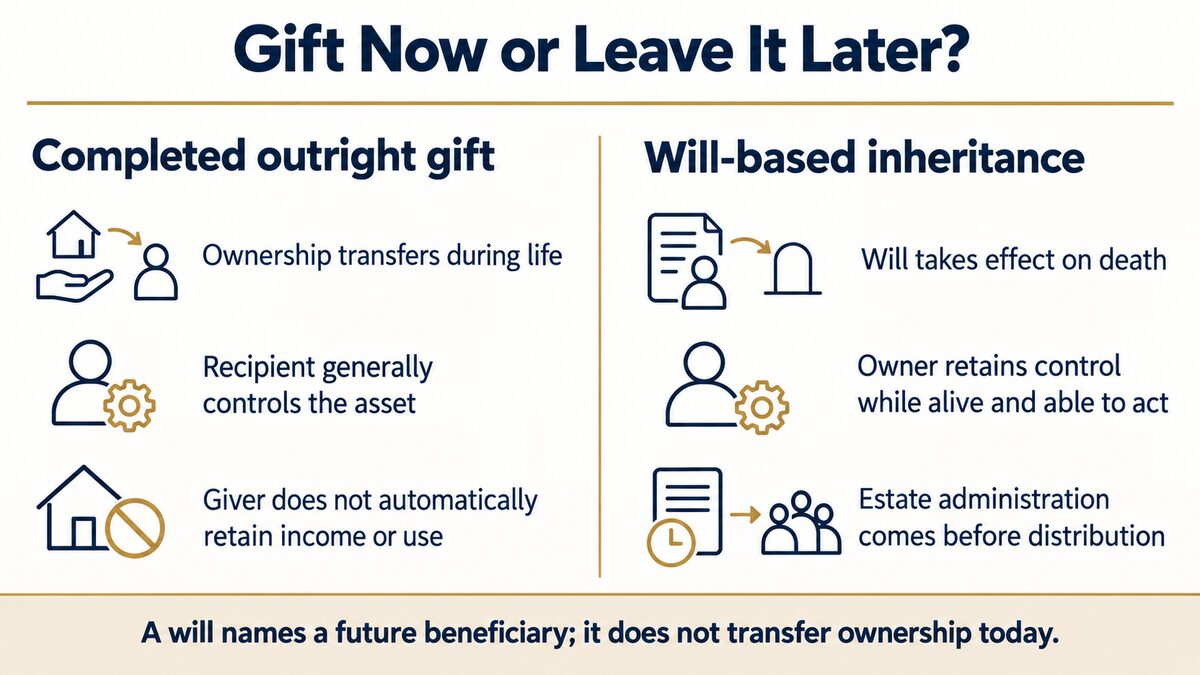
Before gifting assets to a child, ask what you expect to keep: the rent, a place to live, the right to sell, or the ability to change your mind. An outright lifetime gift and an inheritance treat those expectations very differently.
A completed outright gift generally transfers ownership during your lifetime. Leaving an asset through a will keeps ownership with you while you are alive, with distribution taking place through estate administration after death. A promise that “this will be yours one day” does neither by itself.
The will-based examples below concern non-Muslim estates in Peninsular Malaysia. Muslim succession follows a different framework, and Sabah and Sarawak have separate land and succession laws.
The transfer date decides who controls the asset
Naming your daughter in a will does not make her the current owner of the apartment. While you remain its owner and can validly act, you generally retain the choice to rent it, sell it or change your will, subject to any existing obligations.
An outright gift changes that position once it is legally completed. The recipient generally gains the rights that come with ownership. If you later need the property back, you cannot assume that changing your will or withdrawing your earlier intention will reverse the transfer.
Completion depends on the asset. For registered land in Peninsular Malaysia, handing over keys or signing a family gift letter does not by itself change the registered owner. JKPTG’s guidance on transfers without consideration describes the transfer form, valuation and stamping steps before presentation at the land office.
| Asset | What completing the gift involves |
| Cash | Delivering the funds as a gift, with a clear record of the amount, recipient and intention. |
| Registered land | The required transfer documents, applicable consents, stamping and registration. |
| Private company shares | The transfer instrument, stamping, lodgement with the company and the necessary register updates, subject to transfer restrictions. |
For private company shares, sections 105–106 of the Companies Act 2016 address the transfer instrument and registration process. An announcement that a child will “take over the shares” does not replace those steps or override restrictions in the company’s constitution.
A gift can remove income as well as ownership
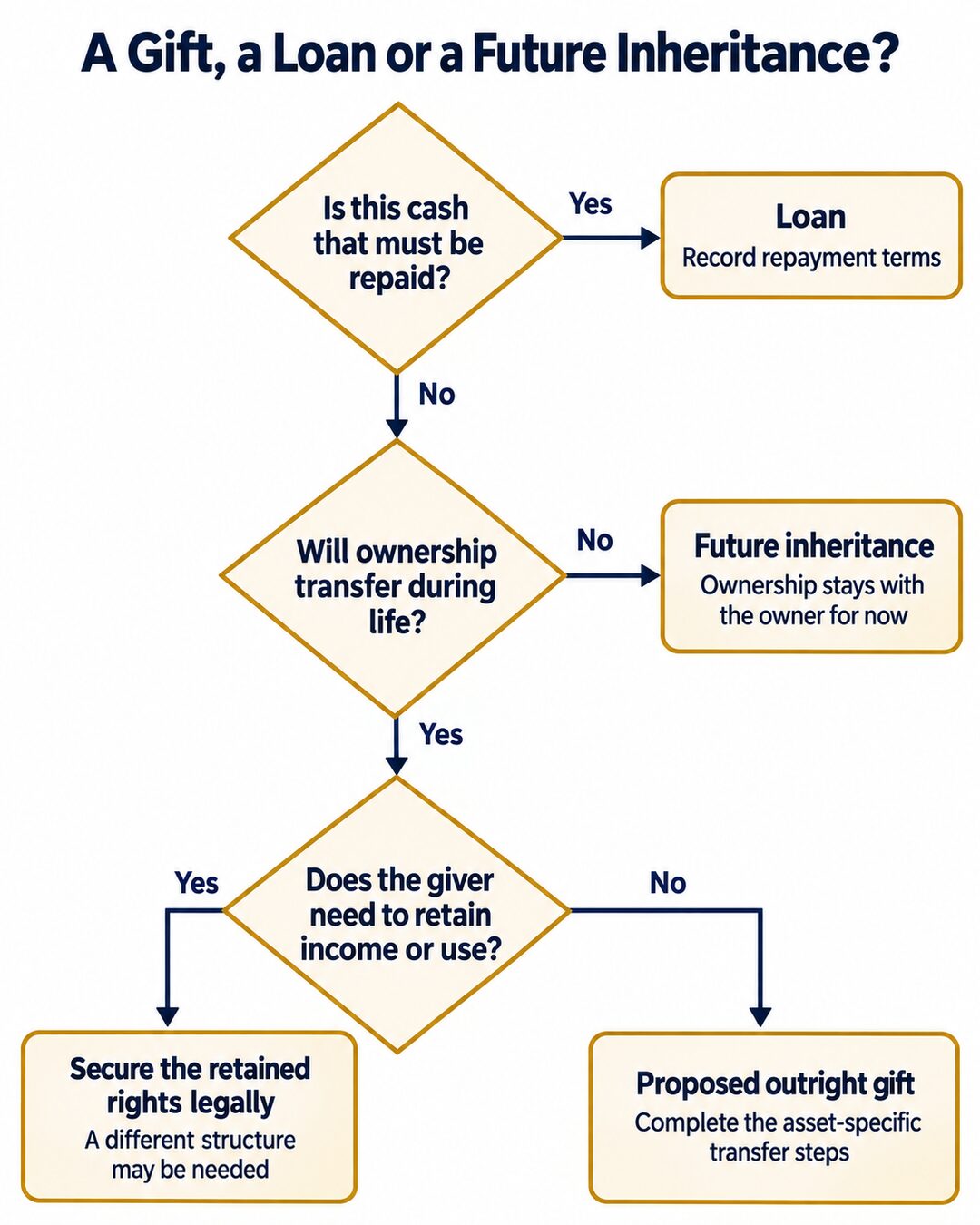
Suppose a parent gives a rental apartment to an adult son but expects to keep receiving the rent. The son agrees, so the family treats the matter as settled. The difficulty appears later, when the son wants to sell or the parent needs a legally enforceable right to that income.
Continuing to receive rent in practice is different from having a secured right to receive it. An outright transfer does not automatically reserve rental income or a right to occupy the property for the giver. Any retained benefit needs a legally effective arrangement, which may require a different structure from an outright gift.
The recipient’s circumstances also become relevant. If the child dies before the parent, the parent cannot assume the gifted asset will automatically return. Once ownership has passed, the child’s own estate and succession arrangements may determine what happens to it.
An outstanding loan creates another issue. Transferring ownership does not, by itself, release the existing borrower from the debt. A child’s promise to pay the instalments is not the same as the lender agreeing to release the parent or replace the borrower.
The documents must reflect what the family actually intends
A gift, a loan and a future inheritance can all begin with a parent helping a child. Their consequences are different. If repayment is intended, describing the payment as a gift creates an avoidable dispute about whether the child owes the money back.
For cash, record whether the payment is an unconditional gift or a loan, the amount and the date. A loan also needs repayment terms. For property, the transfer documentation must deal with the asset and any retained rights; a bank transfer record or family message cannot perform that work.
A lifetime transfer can also change the balance of the remaining inheritance. A parent may intend a cash gift to count towards one child’s eventual share, while the child understands it as extra support. Record that intention and reflect it in the estate documents, rather than leave the executor to infer an adjustment later.
A will cannot distribute an interest the parent no longer owns. After gifting assets, provisions that still refer to them can leave the family with expectations the estate cannot fulfil. The remaining estate plan has to reflect what is still owned and any interests that have actually been retained.
For Muslim families, hibah and wasiat arrangements operate within a different legal framework, alongside faraid. The validity and completion of a hibah, and the limits on testamentary gifts, cannot be inferred from the conventional will examples above.
A family transfer can still carry costs
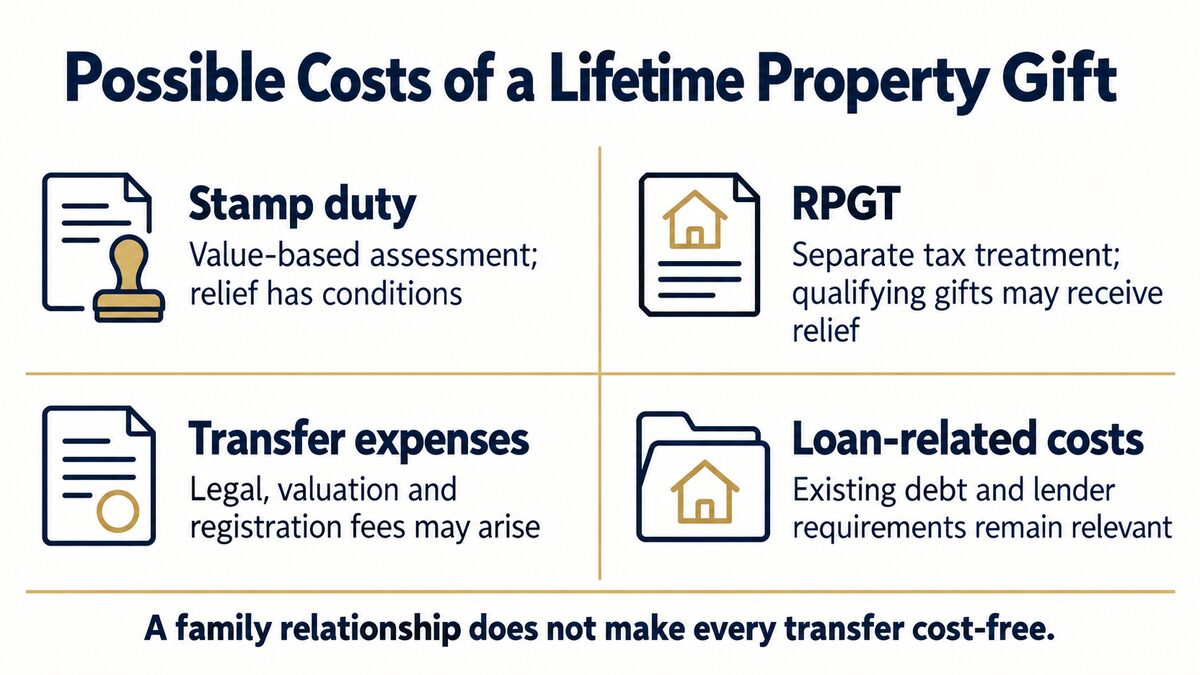
No purchase price does not mean no transfer costs. For property, the Valuation and Property Services Department’s stamp duty guidance explains the value-based assessment. A gift can therefore involve stamp duty calculated by reference to market value, even when the recipient pays nothing for the property.
Family-transfer exemptions and remissions have their own conditions. The precise relationship, citizenship requirements and applicable instrument matter. An exemption available for one parent-to-child transfer should not be assumed to cover every transfer between relatives.
Real Property Gains Tax (RPGT) is separate from stamp duty. HASiL’s guidance on gifts states that qualifying gifts between spouses, parents and children, or grandparents and grandchildren receive no-gain-no-loss treatment where the donor is a Malaysian citizen. That treatment concerns the giver’s disposal; it does not establish the recipient’s tax position on a later sale.
Legal fees, valuation and registration expenses, and loan-related costs may also arise. A transfer involving a charged property can require lender involvement and changes to the financing arrangements, even where tax relief applies.
Leaving an asset in an estate also involves administration and transfer work after death. The useful comparison is the actual cost of each route for that asset, including who will fund it, rather than whether the family calls the transfer a gift or an inheritance.
Decide what you can afford to give away
A gift can solve a real need now. Cash towards a home deposit may be more useful to a child today than the same amount received years later. The question is whether giving it leaves the parent with enough accessible money and reliable income for their own life.
For a parent relying on rent, the amount given away includes the income attached to the property as well as its capital value. If that rent pays household expenses or medical insurance, replacing it becomes part of the cost of the gift.
Property wealth alone does not answer that question. A family home may be valuable but difficult to use for an urgent care bill without selling or borrowing. The assets retained after gifting need to work for likely living and care expenses, including a period when the parent cannot earn additional income.
There is no need to make every asset follow the same timetable. A parent may make a limited cash gift now while retaining an income-producing asset and leaving its eventual destination to the estate plan. The scope of the gift can match the help the child needs without committing the parent’s entire financial reserve.
If a proposed gift depends on you continuing to receive rent or live in the property, contact Sim & Rahman to discuss how to protect those rights before transferring ownership.