
Naming a guardian for your minor child in Malaysia does not automatically give that person control of the child’s inheritance. Leaving money to your child does not automatically ensure that somebody can use it for school fees, medical care and daily living expenses.
These are two separate decisions.
The guardian is concerned with the child’s life: where the child lives, who makes healthcare decisions and how the child is educated. The executor and trustee are concerned with the assets: collecting the estate, paying liabilities, managing the inheritance and releasing money under the terms of the will or trust.
One trusted relative may be suitable for all three appointments. In another family, giving one person every responsibility may create more risk than convenience.
The right arrangement begins by understanding what each person can—and cannot—legally do.

If You Name Someone in Your Will, Will They Automatically Raise Your Child?
Not in every situation.
For a non-Muslim family in Peninsular Malaysia, a parent may appoint a guardian through a deed or will. However, the appointment does not automatically displace the child’s other living parent.
If one parent dies, the surviving parent remains a guardian. A person appointed by the deceased parent will generally act jointly with the surviving parent.
If the surviving parent objects, or the appointed guardian believes that the surviving parent is unfit, the issue may have to be decided by the Court. The Court may leave the surviving parent as sole guardian, order both adults to act jointly or appoint the testamentary guardian as sole guardian.
The child’s welfare is the primary consideration.
This is why a divorced parent should not assume that naming a sibling in a will will automatically prevent the former spouse from caring for the child after the parent’s death. The will records the parent’s choice, but it does not remove the Court’s responsibility to consider the surviving parent and the child’s circumstances.
If both parents have died, a guardian appointed in the will is in a much clearer position to step forward. If neither parent made an appointment, the Court may need to appoint a guardian of the child’s person, property or both.
Under the Guardianship of Infants Act 1961, a guardian of the child’s person is responsible for custody, support, health and education.
The law does not simply award the role to the closest relative. A grandparent, aunt, uncle or adult sibling may be deeply involved in the child’s life, but family closeness alone is not the same as a formal appointment.
The right guardian must fit the child’s actual life
Before naming anyone, parents should look beyond whether the person is kind and trustworthy.
Would the child have to move to another state or country? Can siblings remain together? Would the guardian respect the child’s existing school, language, religion and relationship with both sides of the family? Has the person agreed to take on the responsibility?
A suitable guardian should also have a substitute. The first choice may become unwell, move overseas, die before the parents or simply be unable to act when the time comes.
Can the Guardian Spend or Invest the Child’s Inheritance?
Not merely because that person is raising the child.
Suppose a will leaves RM2 million to a ten-year-old child and names the child’s aunt as guardian. The aunt may be responsible for the child’s home, health and education, but she does not automatically acquire the right to withdraw RM2 million, sell inherited property or manage a share portfolio.
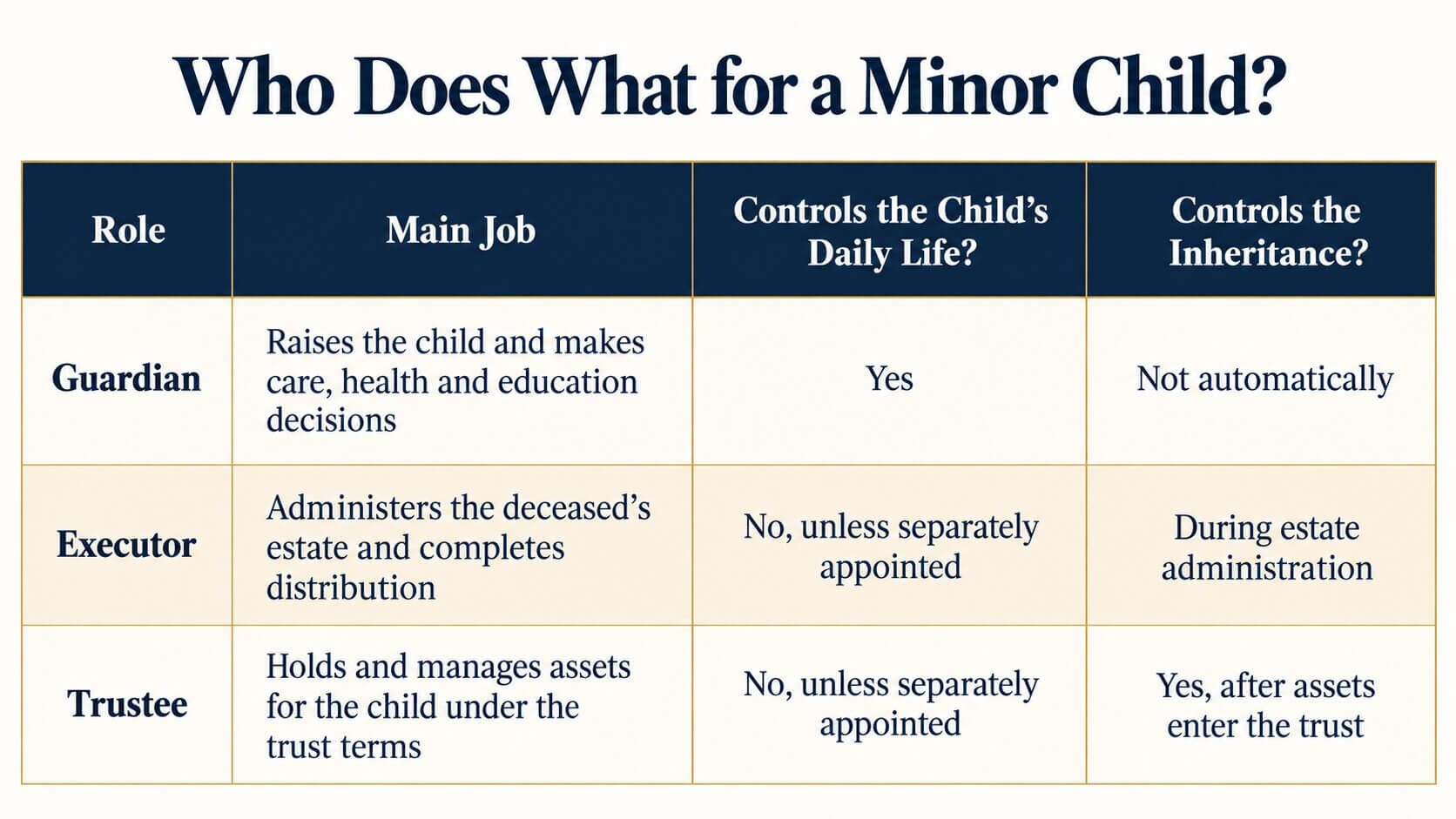
The inheritance may pass through three different hands for three different purposes:
| Person | What This Person Does | What This Person Does Not Automatically Control |
| Guardian | Raises the child and makes decisions about daily care, health and education | The estate, trust fund or inherited assets |
| Executor | Obtains probate, gathers the deceased’s assets, pays debts and administers the estate | The child’s daily upbringing unless also appointed guardian |
| Trustee | Holds and manages the child’s inheritance under the will or trust | Custody of the child unless also appointed guardian |
The executor’s role is usually connected to estate administration. Once the debts and expenses have been dealt with, assets intended for the minor may be transferred to the trustees to hold under the terms of the will.
The trustee then decides how the trust assets are invested and when money may be used for the child. The guardian may request funds, but the trustee must follow the trust terms and exercise the trustee’s own legal duties.
Who pays the child’s expenses while the estate is being administered?
This is the point many wills fail to address practically.
The estate may contain substantial wealth, yet the guardian may need cash immediately for school fees, transport, medical treatment or a larger home. Probate and estate administration take time. The guardian cannot assume that the deceased’s bank accounts will be available on demand.
A complete plan should therefore consider both long-term inheritance and short-term liquidity. Depending on the family’s circumstances, that may involve cash reserves, appropriately structured insurance, trust arrangements or other assets that do not all depend on the same probate timeline.
The different documents must also point towards the same intended result. Insurance nominations, trusts, ownership arrangements and the will should be examined together through a Family Asset Execution Plan rather than treated as separate paperwork.
Should the Guardian and Trustee Be the Same Person?
They can be, but they do not have to be.
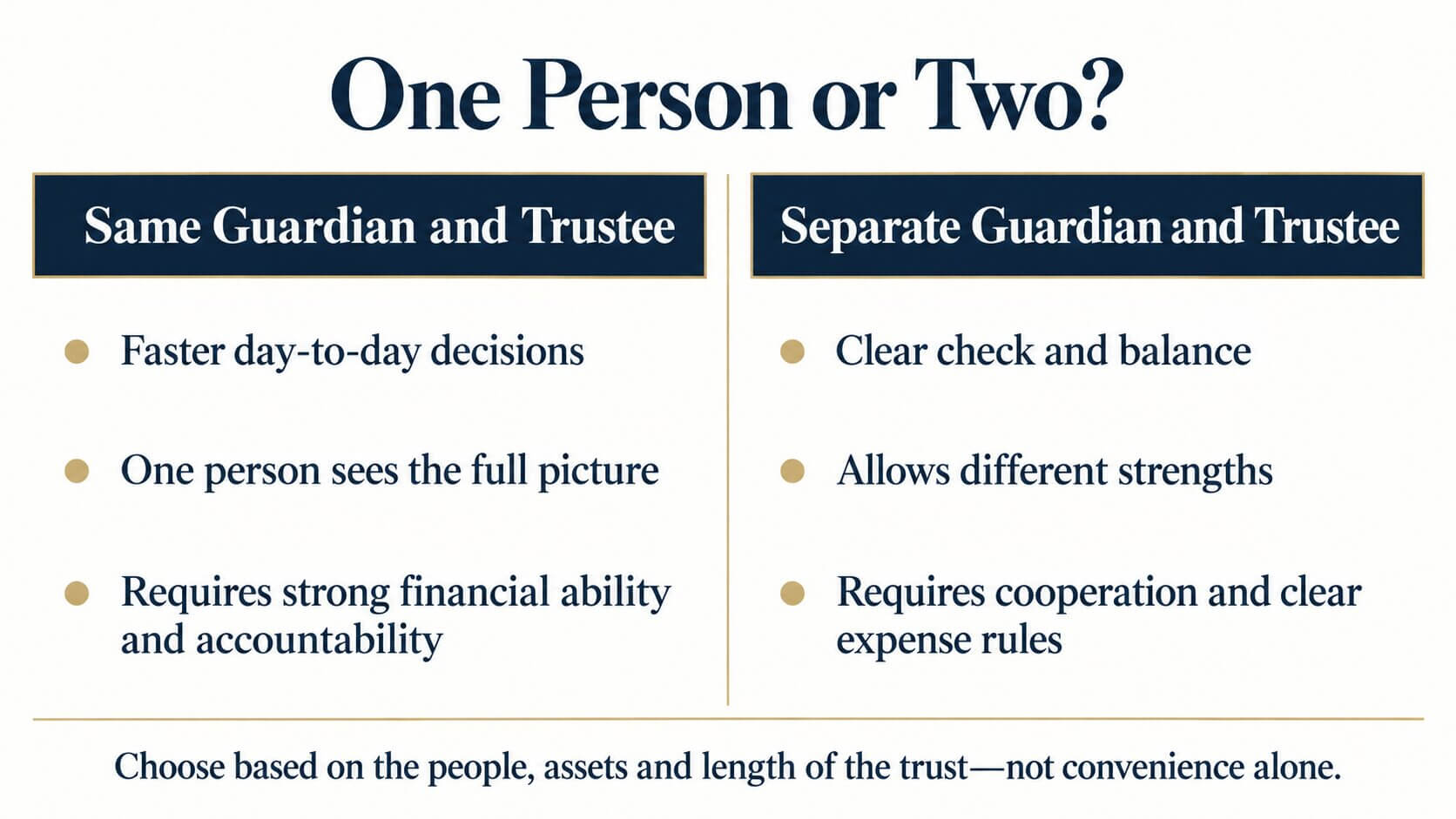
Appointing the same person may make everyday decisions easier. The guardian does not need to explain each expense to another relative, and one person has a complete view of the child’s needs and available resources.
That arrangement may work when the proposed guardian is financially capable, has time to manage the assets and can maintain clear records. It may be less suitable when the inheritance includes investment properties, a business, overseas assets or a large portfolio requiring specialist judgment.
Giving the roles to different people creates a check and balance. The guardian focuses on the child; the trustee protects and manages the money.
However, separation only works if the two people can cooperate.
Imagine that the guardian wants to move into a larger home so the child can have a bedroom. The guardian asks the trustee to use part of the inheritance for the renovation or purchase. The trustee worries that the money will also benefit the guardian’s own family.
Neither concern is unreasonable. Without clear instructions, the dispute becomes personal: one person feels that the child’s needs are being denied, while the other believes the inheritance is being eroded.
Parents should therefore decide how the arrangement will handle questions such as:
- Will the trustee pay the school or medical provider directly?
- Will the guardian receive a fixed monthly amount or claim actual expenses?
- Can trust money contribute to housing used by both the child and guardian?
- Who approves an emergency expense?
- Must the trustee consult the guardian before changing investments?
- What happens if the guardian and trustee cannot agree?
The will can give the trustee discretion, but the purpose of that discretion should be clear. A separate letter of wishes may explain the parents’ priorities and family context, although it should support rather than replace properly drafted legal provisions.
When separating the roles makes more sense
A separate trustee may be especially useful when:
- The guardian is caring and dependable but uncomfortable managing money
- The inheritance is large, complex or expected to remain invested for many years
- The child will inherit private-company shares or income-producing property
- The guardian has personal debts or financial pressures
- Several children or households must be treated fairly
- A neutral professional is needed to reduce conflict between family members
Parents may appoint suitable individuals, a trust corporation or an appropriate combination, depending on the assets and the length of the trust.
When Should the Child Receive Control of the Inheritance?
The child does not necessarily need to receive the entire inheritance as soon as the earliest legally available age is reached.
A will or trust may be structured so that the trustee holds assets for a longer period and uses them for the child’s maintenance, education and benefit, subject to the applicable law and the wording of the document.
The Trustee Act 1949 contains default powers concerning the use of trust income for a minor’s maintenance, education or benefit. A carefully drafted document can go further by explaining the intended purposes, the trustee’s discretion and the conditions for releasing capital.
For example, the trustee might be authorised to pay for education and medical needs throughout childhood, release part of the inheritance at a specified age and retain the balance until a later age or milestone.
The structure should fit the asset.
Cash can be released in stages. A home may need to be maintained until the child decides whether to occupy or sell it. Company shares may need to remain under professional management so that the child receives economic value without disrupting the business.
Parents should be careful with rigid milestones. A direction to release money only after graduation may not work if the child chooses vocational training, enters the family business or has a disability that changes the expected path.
The trustee needs enough flexibility to respond to the child’s real circumstances, but not so much that the parents’ intentions disappear.
The age at which guardianship ends and the age at which trust capital is distributed are different legal questions. The guardian does not continue controlling the inheritance simply because the guardian raised the child, and the trustee does not gain authority over the child’s upbringing merely because the trustee holds the money.
Where the inheritance includes a family company, the will must also be coordinated with the company constitution, shareholders’ agreement and succession arrangements. The person safeguarding the child’s shares may need very different skills from the person providing the child’s home.
What Exactly Should Parents Put in Place?
A minor-child plan should make the following decisions explicit:
- The first-choice guardian and a substitute
- The executor responsible for administering the estate
- The trustee or trustees responsible for managing the inheritance
- The purposes for which money may be used while the child is young
- The process for the guardian to request routine and emergency funds
- The age or conditions for distributing the inheritance
- The treatment of the family home, company shares and other assets that cannot simply be divided as cash
- The location of the original will, asset records and the child’s essential care information
The guardian and trustee should both know that they are being considered. A name written in a will is of limited practical value if the person refuses the appointment, cannot work with the other adults or does not understand what the parents expected.
The executor must also be able to find the assets and begin the probate process without piecing the family’s finances together from old emails and bank statements.
This article focuses mainly on non-Muslim families in Peninsular Malaysia. Muslim families and families connected to Sabah or Sarawak may be subject to different guardianship, inheritance and customary rules. Muslim parents should coordinate guardianship with appropriate Islamic estate-planning arrangements, including Hibah and Wasiat where suitable.
Before finalising the will, write down the guardian, executor and trustee on the same page. Beside each name, state the job that person is expected to perform and how the child’s expenses will actually be paid. If the responsibilities overlap, conflict or depend on money that may not yet be accessible, turn those intentions into a legally workable arrangement while the choices still belong to you.
This article provides general information only and does not constitute legal advice. The applicable outcome depends on matters including the child’s and parents’ religion, domicile and location, the surviving parent’s circumstances, the terms and validity of the will or trust, the nature of the assets and any Court order.


