

When assets are frozen after death in Malaysia, a family can be legally entitled to inherit and still be unable to access the money, transfer the property or deal with the deceased’s shares.
The death certificate proves that a person has passed away. It does not automatically give the spouse, children or other beneficiaries authority to operate the deceased’s bank accounts or dispose of assets held in the deceased’s sole name.
For many families, the real question is therefore not only “Who inherits?” It is also “How many months—or possibly years—will pass before the inheritance can actually be used?”
The answer depends on the legal route, the documents available, the assets involved and whether anyone contests the estate.

What Does It Mean When an Estate Is “Frozen”?
“Frozen” is a practical description rather than a single legal status applied identically to every asset.
Once a bank or financial institution is notified of an account holder’s death, it will generally restrict dealings with accounts held solely in the deceased’s name. A house registered solely to the deceased cannot simply be transferred or sold by a family member, and shares registered in the deceased’s name cannot ordinarily be dealt with as if the shareholder were still alive.
The restriction exists because the institution needs proof that the person giving instructions has legal authority to represent the estate. Family relationship alone is usually not enough.
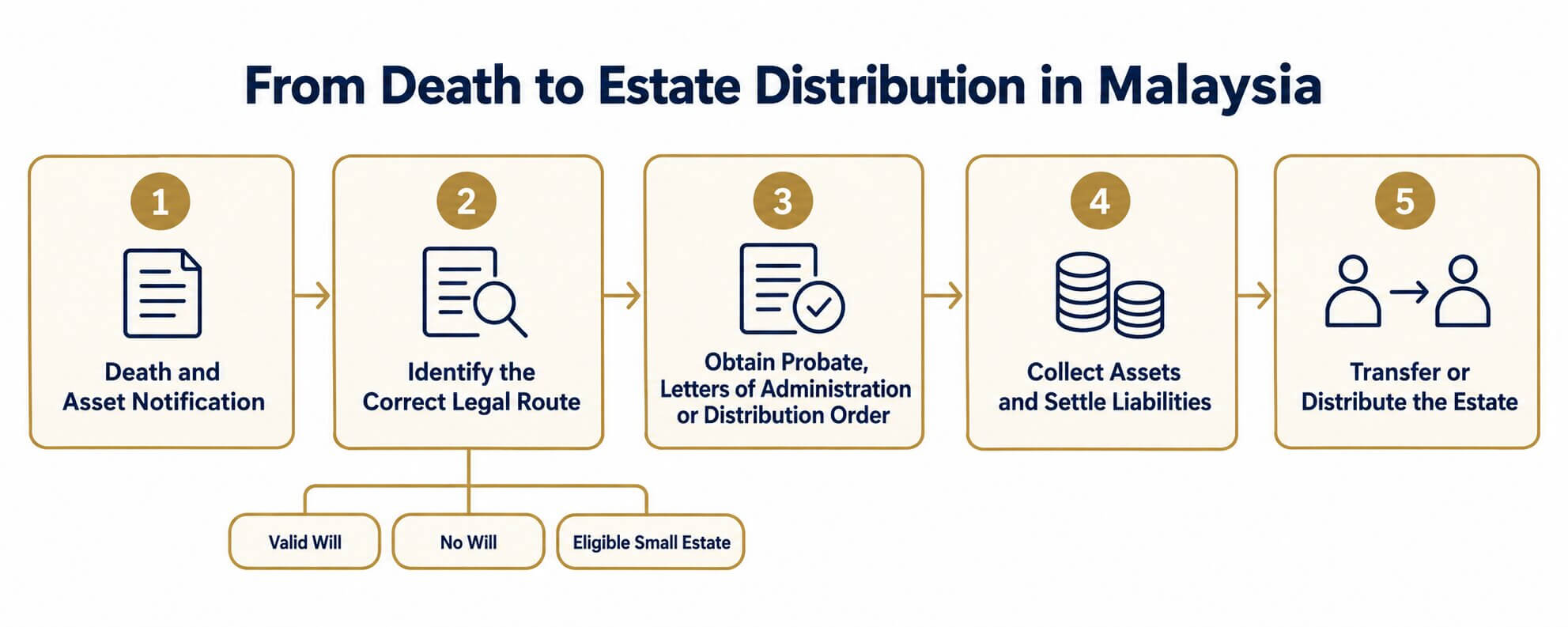
Depending on the estate, the required authority may be:
- A Grant of Probate when the deceased left a valid will and appointed an executor
- A Grant of Letters of Administration when there is no valid will or no executor able to act
- A Distribution Order or Letters of Administration issued through the small-estate process
- An appropriate instrument or direction issued by Amanah Raya Berhad in applicable cases
Not every asset is treated in the same way. Joint accounts, jointly owned properties, nominated benefits, insurance proceeds, trust assets and company-owned assets may follow different rules or institutional procedures.
That is why families should first identify which assets form part of the estate instead of assuming that everything is either fully frozen or immediately available.
How Long Can Your Family Actually Be Waiting?
There is no single probate timeline that applies to every Malaysian estate.
A straightforward estate with a valid will, an available executor, a complete asset list and no dispute may move considerably faster than an estate without a will. However, obtaining the grant is only one part of the process.
The executor or administrator may still need to collect the assets, settle debts, deal with tax matters, sell or transfer property and complete the distribution to beneficiaries.
| Estate Situation | Likely Legal Route | What Determines the Waiting Time? |
| Valid will and appointed executor | Grant of Probate through the High Court | Validity of the will, completeness of documents, court processing and whether a caveat or dispute exists |
| No valid will | Letters of Administration through the High Court | Agreement on the administrator, beneficiary documents, administration bond or dispensation issues, asset details and disputes |
| Estate eligible for the small-estate process | JKPTG small-estate application | Completeness of the application, hearing date, attendance or consent of heirs, property records and office backlog |
| Assets or beneficiaries in more than one country | Grant, resealing or additional foreign procedures | Foreign laws, translations, overseas institutions and coordination between advisers |
| Family or ownership dispute | Court proceedings may be required | Nature of the claim, evidence, settlement attempts and litigation timeline |
For eligible small estates, JKPTG states that the general completion period is approximately four to six months from the application date. It also warns that offices with high case volumes or backlogs may take longer.
This four-to-six-month reference should not be treated as a guaranteed deadline. It begins from the application—not automatically from the date of death—and assumes that the matter is suitable for the small-estate route.
For High Court probate and Letters of Administration matters, families should be cautious about promises of a fixed completion date. The timeline depends on the facts of the estate, court requirements and whether further documents or orders are needed.
Most importantly, receiving a grant does not mean every beneficiary is paid on the same day. It gives the executor or administrator authority to begin or continue administering the estate lawfully.
What Happens to the Family While the Estate Is Being Administered?
The estate may contain substantial wealth while the family has very little immediately available cash.
This is especially serious when the deceased was responsible for most household expenses or held important family assets in his or her sole name.
Household Commitments Do Not Pause Automatically
Mortgage instalments, property maintenance, insurance premiums, school fees and daily living expenses may continue even when the deceased’s personal accounts can no longer be used freely.
If the surviving spouse has limited savings outside the estate, several months of administration can create pressure despite the family’s eventual inheritance.
A Property May Be Valuable but Unable to Produce Cash
A family home worth RM2 million does not solve an immediate RM20,000 cash-flow need if nobody has authority to sell, refinance or transfer it.
Even after the appropriate grant is obtained, the executor or administrator may need further time to complete a sale, obtain consents, redeem financing or register a transfer.
A Business May Lose an Active Decision-Maker
Where the deceased owned company shares, the shares may form part of the estate. Before transmission is completed, the family may face uncertainty over voting rights, dividends, board control or the eventual ownership of the shares.
Company documents, shareholder agreements and succession arrangements may reduce this risk, but they must be reviewed before a death occurs. A personal will alone may not resolve every operational issue affecting the company.
Beneficiaries Cannot Divide the Estate Informally
Family members may all agree on what the deceased “would have wanted”, but they should not withdraw, sell or transfer estate assets without proper authority.
Unauthorised dealings can create disputes, personal liability and difficulties when formal administration eventually begins.
If the deceased left no valid will, the family may first need to agree on who will apply to become the administrator. The Letter of Administration process in Malaysia explains why an authorised representative is necessary before the estate can be managed and distributed.
What Causes an Estate to Remain Frozen for Longer?
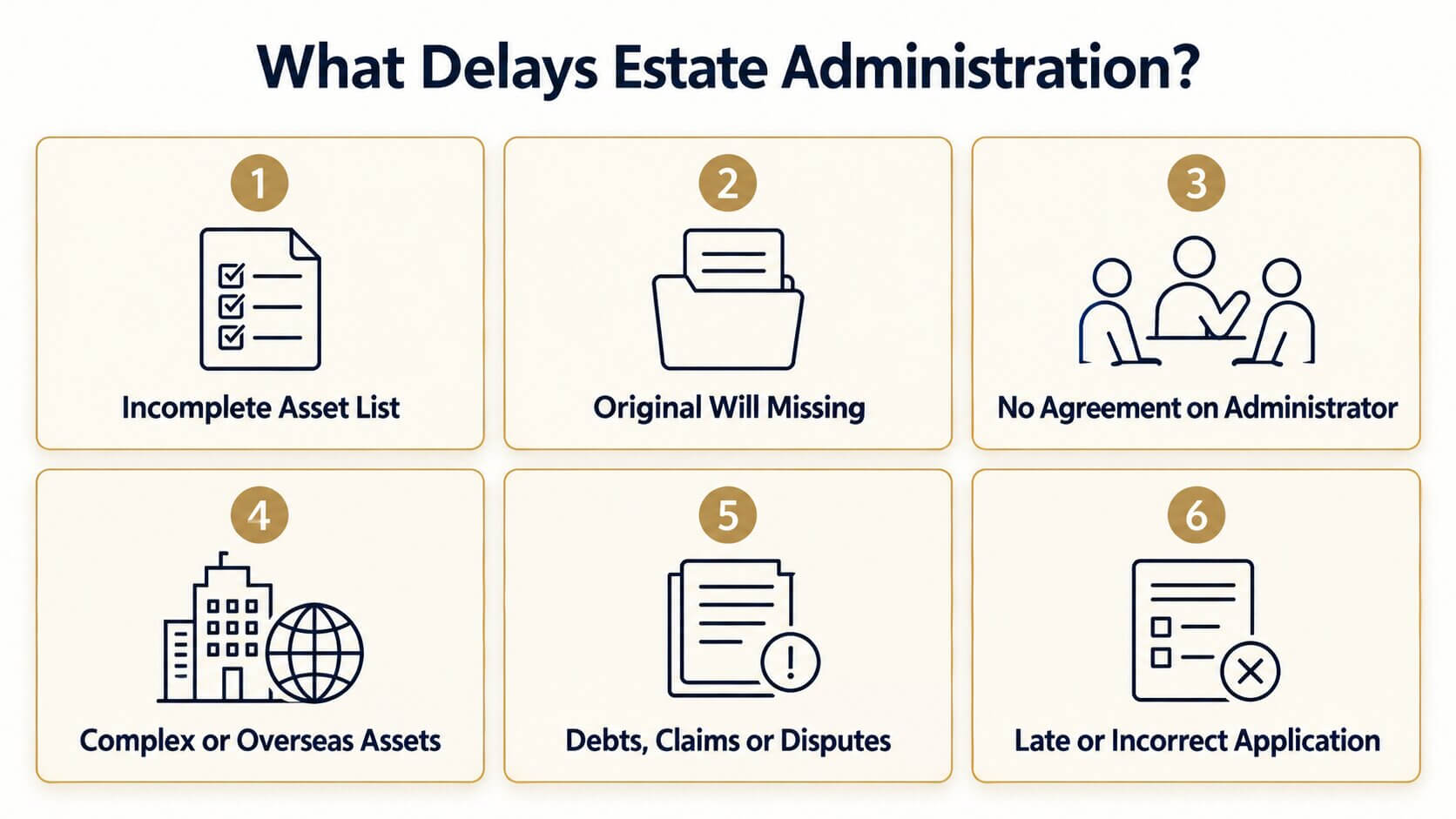
Delays usually do not come from one dramatic legal problem. They often result from several smaller issues appearing at the same time.
1. Nobody Has a Complete List of Assets
The family may know about the house and main bank account but not the deceased’s other deposits, investment accounts, private company shares, safe-deposit box, overseas assets or outstanding loans.
The application cannot be prepared properly until the estate is identified and valued with reasonable accuracy.
2. The Original Will Cannot Be Found
A photocopy, unsigned draft or outdated version may create questions about whether a valid original will exists.
Time may then be spent searching for the document, contacting the drafting firm or determining whether another legal route is required.
3. The Family Cannot Agree on the Administrator
When there is no valid will, selecting the person who will administer the estate can itself become a source of delay.
Some beneficiaries may need to provide consents or renounce their right to apply. If they refuse, cannot be located or dispute the proposed administrator, the matter may become more complicated.
4. The Estate Contains Property, Private Companies or Overseas Assets
Complex assets require more than a simple bank withdrawal. Valuations, title searches, company records, foreign grants, translations or regulatory approvals may be required.
The family may also have to decide whether an asset should be transferred, retained or sold before the proceeds can be divided.
5. There Are Debts, Claims or Disputes
An executor or administrator should not distribute the entire estate without addressing valid liabilities.
Creditor claims, challenges to the will, disputes over ownership or allegations involving lifetime transfers can prevent an early distribution.
6. The Application Was Started Late or Filed Through the Wrong Route
Families sometimes wait because they believe assets will transfer automatically. Others begin with the wrong authority because they have not considered the estate’s value, asset composition, existence of a will or the deceased’s domicile.
Correcting an unsuitable application can add more time to an already delayed estate.
How Can You Reduce the Waiting Time for Your Family?
No estate plan can guarantee that every institution, court or beneficiary will act within a fixed period. However, good preparation can remove many avoidable sources of delay.
Prepare a Valid Will and Choose an Executor Carefully
A valid will identifies the intended executor and reduces the need for the family to decide who should apply after death.
The executor should be willing, capable and aware of the responsibility. Naming someone without discussing the appointment may create another delay if that person later refuses or is unable to act.
Maintain an Updated Asset and Liability Record
The record should help the executor locate bank accounts, properties, investments, company interests, loans, insurance policies and important supporting documents.
It should not expose passwords or sensitive information insecurely. The purpose is to make the estate traceable, not to create a new security risk.
Plan for Immediate Family Liquidity
A family should not have to rely entirely on assets that require months of administration before they can be used.
Cash reserves and properly structured insurance, trust, nomination or ownership arrangements may help provide short-term liquidity. Their legal effect should be checked individually rather than assuming every nomination bypasses the estate.
Coordinate Personal and Business Succession
Business owners should review whether company constitutions, shareholder agreements, signing mandates and succession plans remain workable after a key shareholder’s death.
A Family Asset Execution Plan can help coordinate the people, documents and practical steps required to carry out the wider estate plan.
Review the Plan When Circumstances Change
A marriage, divorce, birth, death, new property, business restructuring or overseas investment may make an earlier plan incomplete.
Regular reviews help ensure that the will, asset list, nominations and ownership structures still work together.
The real cost of a frozen estate is not measured only in months. It can also appear as missed mortgage payments, delayed business decisions, family disagreements and valuable assets that nobody is yet authorised to manage.
If your family would face immediate financial or business pressure while waiting for estate authority, contact Sim & Rahman to discuss how your estate can be prepared for a smoother administration.
This article provides general information only and does not constitute legal advice. The appropriate procedure and timeline depend on the deceased’s circumstances, the type and value of the estate, the existence and validity of a will, the location of the assets and whether any dispute arises.