


Three adult siblings can inherit equal amounts and still need the money in different ways. Planning family trust distributions means deciding whether each person needs capital now, dependable support over time, or money reserved for a later purpose.
One sibling may need a home deposit. Another may have irregular earnings and ongoing care costs. A third may have no immediate need, while their children will eventually need education funding. A single payout date does little to resolve those differences.
Lump sums, regular payments and milestone payments can be combined. The important decisions are what each beneficiary is entitled to receive, what the trustee can decide, and how long the fund can support the arrangement. The examples below concern conventional private family trusts in Malaysia; Islamic and Labuan structures require separate treatment.
Match the payment pattern to the purpose
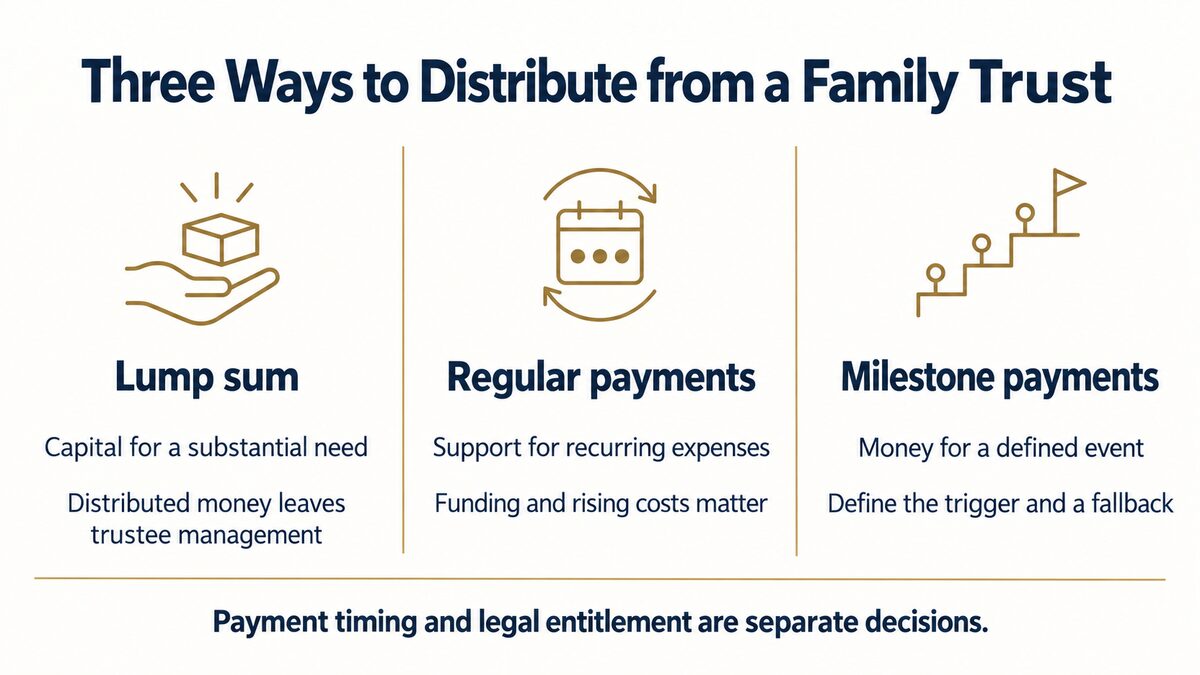
Lump sums give the beneficiary room to act
A lump sum can meet a substantial expense, such as a home deposit, without years of small payments. An outright distribution also gives an adult beneficiary independence over the amount received.
That independence has a consequence: the distributed money is generally outside the trustee’s continuing management. If it is spent quickly, the trust cannot assume it remains available for later care or living costs. A partial lump sum can meet today’s need while leaving a separate reserve under the trust.
Regular payments support recurring expenses
Monthly or quarterly payments can help with rent, household bills or care. They offer a predictable rhythm, but a fixed ringgit amount gradually buys less as costs rise. The terms can provide a defined adjustment method or a power to reconsider the amount.
Regular payments are not necessarily investment income. They may come from income, capital, or both, depending on the trust terms. Calling a payment an “allowance” does not explain how it will be funded.
Milestone payments reserve money for a defined event
A milestone might be reaching an age, completing a course or buying a first home. This can connect a payment to a purpose, but the event needs an objective definition. “Ready to settle down” leaves the trustee guessing.
State the evidence required, the amount or calculation method, and what happens if the event never occurs. A home-purchase provision, for example, can specify a maximum contribution and whether payment goes directly towards completion.
Separate the payment schedule from the right to receive
“Pay monthly” tells the trustee when to pay. It does not say whether the beneficiary has a fixed entitlement or must first obtain approval. That distinction applies to all three payment patterns.
A fixed entitlement commits the trust to the benefit defined in its terms. A discretionary provision instead gives the trustee specified choices, such as whether to approve an additional payment or how much to provide within a permitted class of beneficiaries. Discretion still operates within the trust terms and legal duties.
A combined arrangement might provide a defined monthly amount, allow additional medical support at the trustee’s discretion, and release part of the capital at a stated age. Each part needs its own rules. A power to approve medical expenses does not automatically permit a business investment or an early capital payout.
The beneficiary’s underlying legal entitlement also matters when delaying access. Adult beneficiaries who are legally capable and together absolutely entitled to the whole fund may be able to end the trust early. A later payment date alone does not necessarily prevent this; drafting an age condition requires more than adding a date to a schedule.
Provide an answer when life does not follow the milestones
An education condition may work for one child and obstruct another who develops a disability or chooses vocational training. A marriage condition may delay support indefinitely for someone who remains single. The payment rules need to reflect the purpose of the support, rather than assume every beneficiary will follow the same life.
| If circumstances change | What the terms can specify |
| A course is interrupted or replaced | Whether another recognised course qualifies, or whether a fallback age or alternative purpose applies. |
| Urgent medical or care costs arise | The permitted expenses, evidence required and authority to pay the provider directly. |
| A milestone is never reached | Whether the amount remains reserved, becomes available another way, or passes to another beneficiary. |
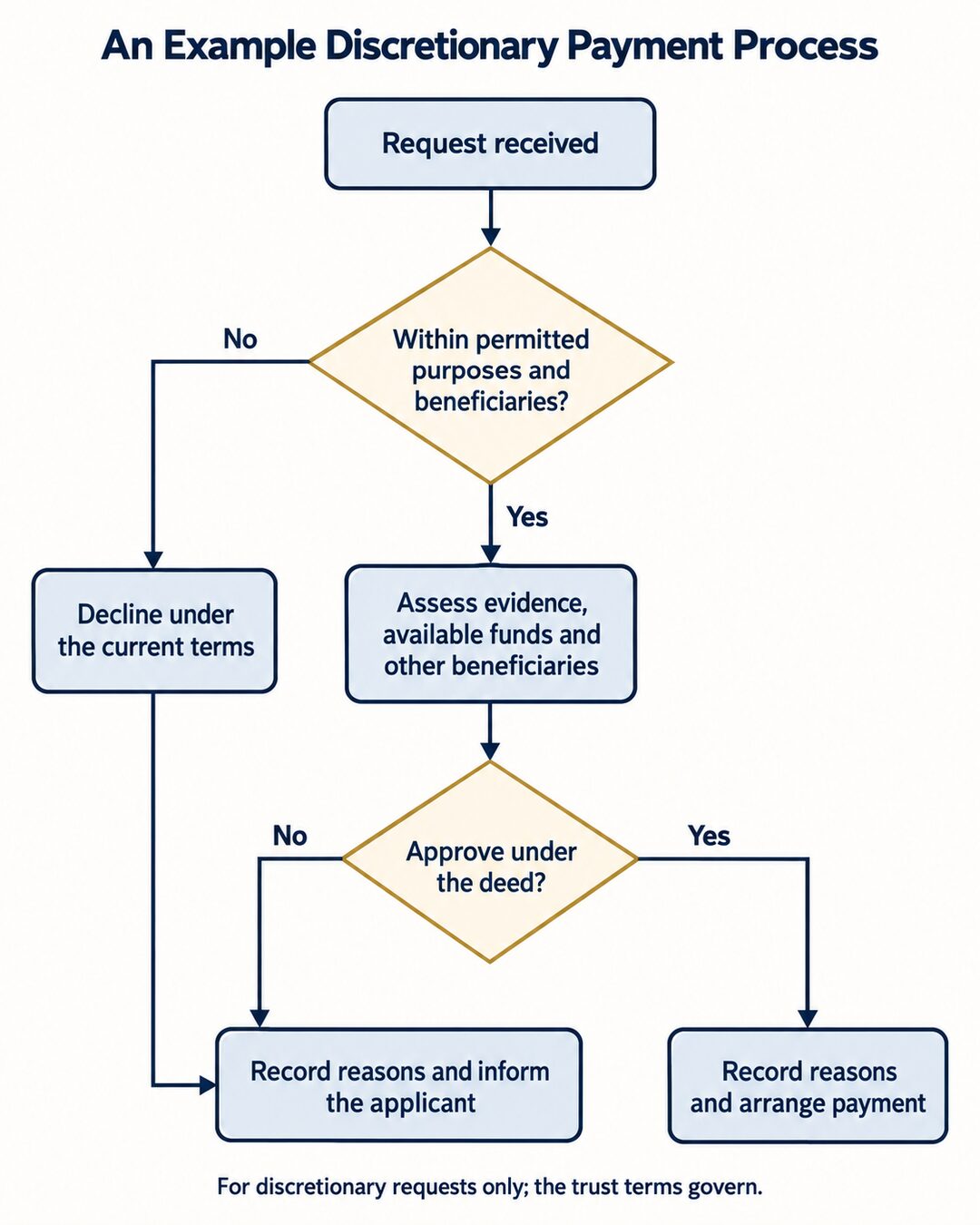
For discretionary requests, a workable process begins with whether the beneficiary and purpose fall within the trustee’s powers. The trustee can then assess supporting documents, available funds and the interests of other beneficiaries, before recording the decision and communicating it. A request outside those powers cannot simply be approved because the family agrees.
A letter of wishes can explain the family’s priorities, but should not be relied on to create a missing payment power. Put the authority for exceptions and any mechanism for changing the arrangement in the trust instrument. A trustee’s ability to exercise an existing discretion is different from a power to rewrite the terms.
Check whether the assets can sustain the payments
A valuable trust can still be short of cash. An apartment may produce no rent during a vacancy, and a family company may retain profits instead of paying dividends. A monthly entitlement backed mainly by those assets needs accessible funds when receipts stop.
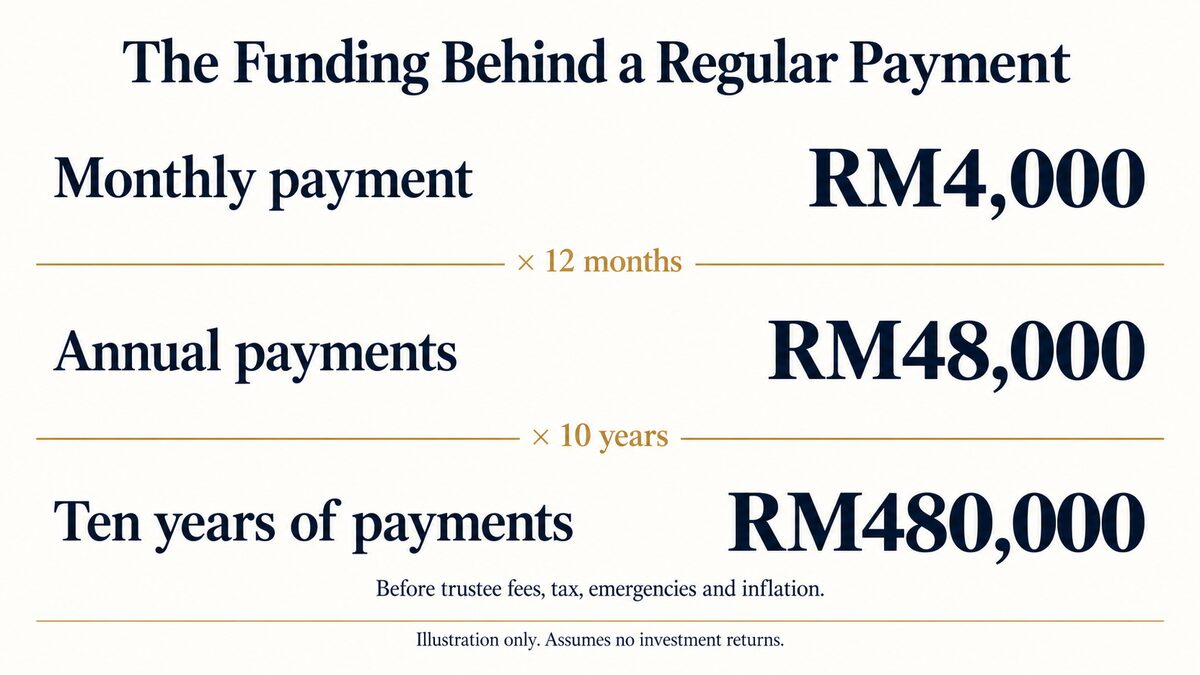
Consider an illustrative payment of RM4,000 a month. That is RM48,000 a year, or RM480,000 over ten years, before trustee fees, tax, emergencies or inflation. This is simple payment arithmetic, assuming no investment returns; it is not a forecast of what a trust will earn.
Distinguish a right to net income from a promise of a fixed amount. Net income can fluctuate. If it falls short of a fixed payment, the arrangement needs a lawful way to use capital or another source of funds; the trustee cannot assume that authority exists.
Once capital is spent, less remains to generate future income or pass to later beneficiaries. Before fixing the schedule, compare expected receipts with payments and expenses, including a period of low income. This connects the distribution rules with the wider plan for the family’s assets.
Decide who benefits from what remains
Preserving money for grandchildren requires an actual provision for them. Define who can benefit from the remaining fund, what happens if a child dies before a milestone, and whether that child’s descendants take a substitute interest. The answer depends on the rights created; an unpaid amount does not automatically pass to the person the family expects.
Also distinguish separate shares from a common fund. Separate shares make it easier to track each child’s allocation. A common fund can accommodate unequal needs if the terms allow, but substantial support for one beneficiary leaves less for others. State whether additional payments count against an eventual share.
The trust also needs a lawful duration and an identified destination for the balance when it ends. “Keep it for future generations” leaves those decisions unresolved. Long-term administration requires a practical way to replace a trustee who dies, retires or can no longer act.
For families with a family office, identify who will coordinate beneficiary requests and records with the trustee.
Before committing to a schedule, contact Sim & Rahman to work through a few concrete situations: a home purchase, a year without rental income, an urgent care bill and a beneficiary who dies before qualifying. The terms should give the trustee a usable answer in each case.