


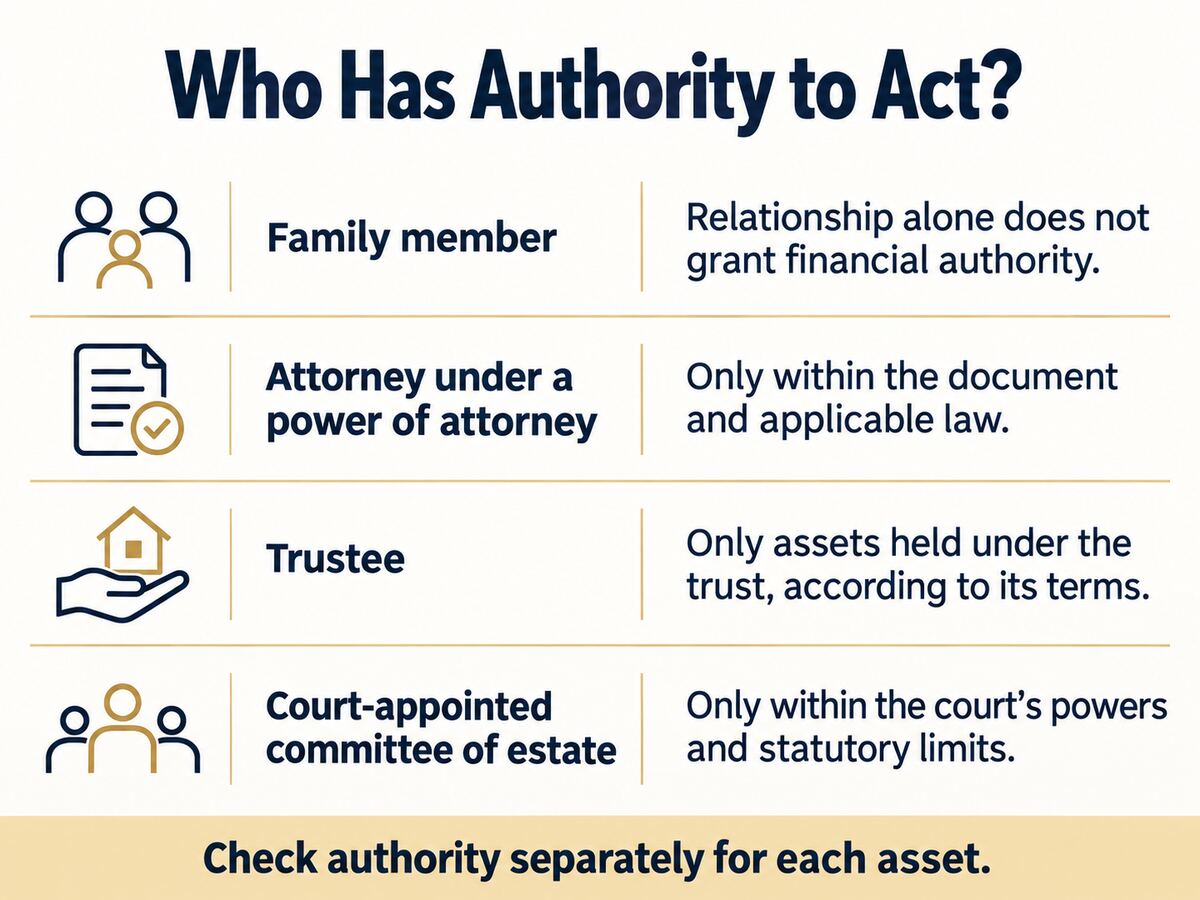
If you lose mental capacity, your spouse or adult children do not automatically gain authority to manage your wealth in Malaysia. Who can act depends on how each asset is held, the legal arrangements already in place and, where necessary, a court order.
A family member has no automatic financial authority; a representative appointed under a power of attorney (POA) can act only within that document and the law. A trustee manages assets held under the trust according to its terms, while a court-appointed committee of estate manages assets within the court’s powers and statutory limits.
Consider a family whose savings, investments and rental property are mostly held in one parent’s name. If that parent can no longer give valid instructions, the family may own substantial wealth yet struggle to use it to pay for care.
Your family needs authority to act
Knowing where the money is does not establish the right to use it. A daughter who has helped with paperwork for years does not acquire authority to redeem her father’s investments simply because he can no longer manage them himself.
A will does not fill this gap. Being named as executor does not confer financial authority during the will-maker’s lifetime. The process for obtaining a grant of probate concerns administration after death.
Mental capacity is also more specific than a diagnosis. For contracts, section 12 of the Contracts Act 1950 asks whether the person can understand the transaction and rationally judge its effect on their interests at the time. Age or a dementia diagnosis alone does not answer that question.
Where capacity is genuinely in doubt, an assessment directed at the proposed transaction helps establish whether the person can give valid instructions. Obtaining a signature alone does not resolve a lack of capacity.
An ordinary power of attorney has limits
A POA can help with a defined task, such as completing a property transaction while the owner is overseas. It allows the representative to carry out authorised acts; it does not transfer ownership of the assets.
Under the general agency rule in section 154 of the Contracts Act 1950, agency ends when the person granting authority becomes of unsound mind. The provision does not make a prior court declaration a condition of termination.
Separately, section 5 of the Powers of Attorney Act 1949 lists the person being adjudged of unsound mind as a terminating event for an ordinary registered power. That court-related event does not mean that agency authority necessarily continues until a court acts.
A dementia diagnosis alone does not settle the legal question of capacity. Equally, the absence of a court order is not proof that an existing authority remains valid. Registration therefore does not make an ordinary POA a guaranteed arrangement for future incapacity.
Specific exceptions for protected powers, and rules about when the representative or a third party learns of termination, can affect particular transactions. Simply labelling a document “irrevocable” does not establish that an exception applies.
The 1949 Act applies to Peninsular Malaysia. The same rules cannot simply be assumed to apply to documents or assets involving Sabah or Sarawak.
The court can appoint someone to manage the estate
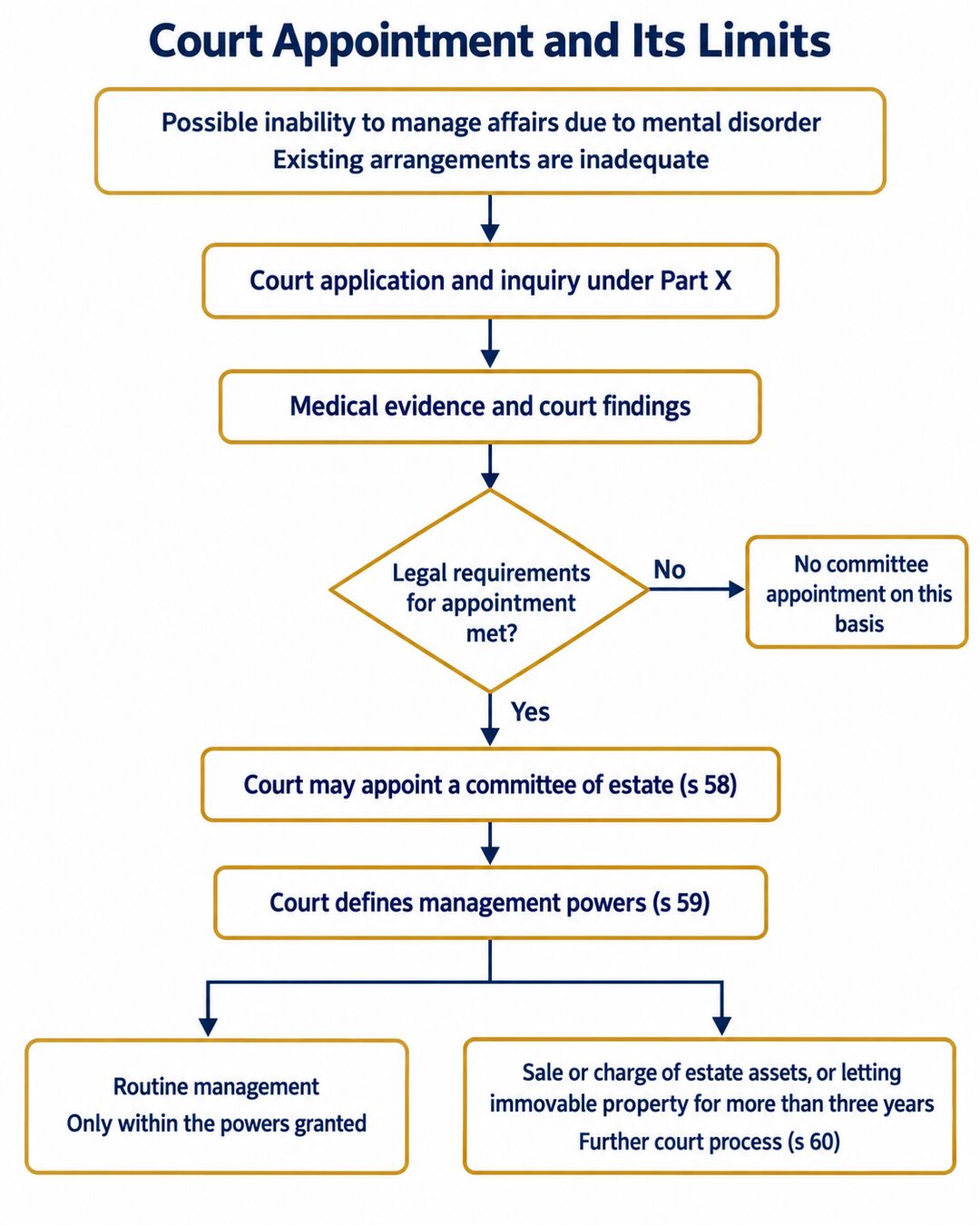
Where a person appears unable to manage their affairs because of mental disorder and existing arrangements are inadequate, a court application may be relevant. Part X of the Mental Health Act 2001 provides for an inquiry into that incapacity.
The court considers medical evidence and decides whether the legal requirements for appointment are met. If they are, it may appoint a committee of estate under section 58. This is the legal role responsible for managing the person’s assets; appointment is not automatic.
The court defines the management powers under section 59. Routine management remains limited to the powers actually granted. These powers do not extend to selling or charging estate assets, or letting immovable property for more than three years.
Those transactions require a further court process under section 60. For example, a family may need to sell an apartment to fund nursing care. Authority to collect its rent does not, by itself, authorise that sale.
A lifetime trust can provide for care expenses
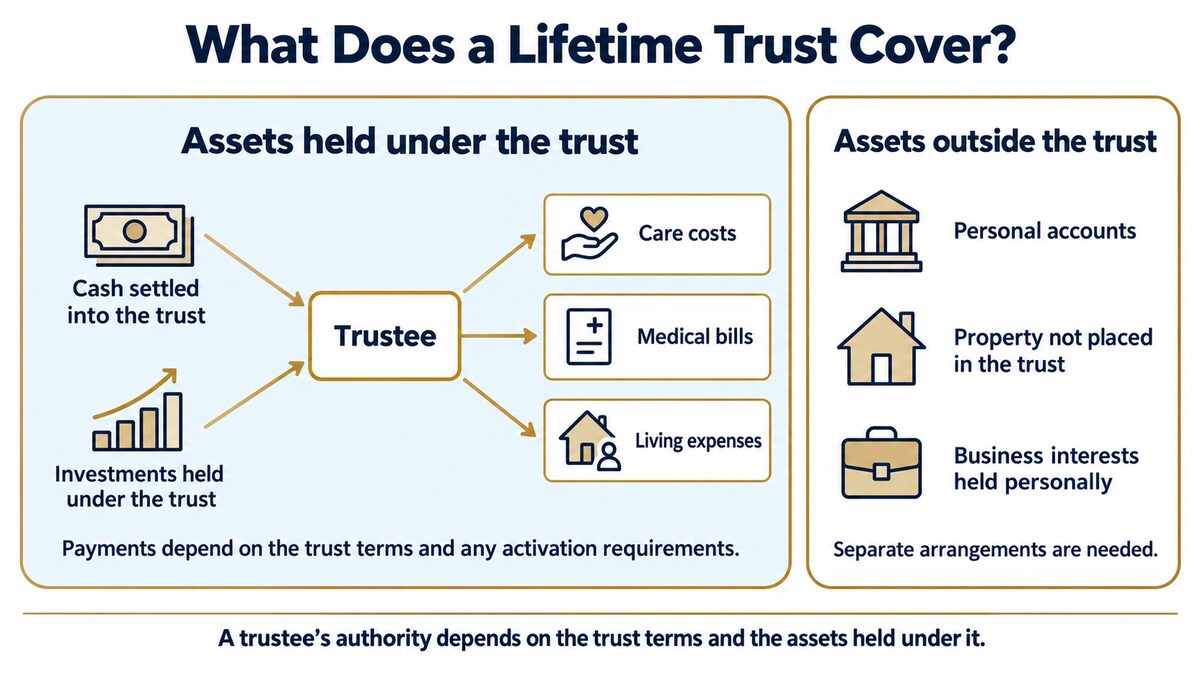
While mental capacity remains, a properly established and funded lifetime trust can place selected assets under a trustee’s management. Its terms can provide for the owner’s maintenance, medical bills and living expenses if incapacity occurs.
Funding is essential. Signing a trust deed does not automatically place every personal account, investment or property under the trustee’s control. If the intended care fund remains outside the trust, the trustee may have no authority over the money needed to pay the bills.
For example, a parent might place cash and suitable investments into a trust for future care. The terms can specify what evidence activates the incapacity provisions, who approves payments and what happens if the parent recovers mental capacity. Unclear activation requirements can delay payments even when the trust has sufficient funds.
A replacement trustee addresses the risk that the original trustee is unavailable. Reporting duties create a record of how money has been spent, which is particularly important when the person receiving care cannot monitor the account themselves.
The funding also has to match the spending. A property may provide rental income without producing enough cash for urgent care costs. Trustee fees reduce the amount available for those costs, and moving mortgaged property into a trust may involve lender consent, registration and transfer costs.
Assets outside the trust remain a separate issue. Funding a care trust does not give its trustee authority over the owner’s remaining personal accounts or business interests.
Match the authority to the transactions your family will need
A plan for loss of mental capacity becomes clearer when it is tested against actual transactions. Paying a care invoice, renewing a tenancy and redeeming an investment may require different people, documents and approvals.
| Asset or responsibility | Transaction and possible obstacle |
| Bank accounts and fixed deposits | Paying care bills or withdrawing a deposit: the bank needs instructions from someone with accepted authority. |
| Investments | Redeeming holdings or dealing with a maturity: knowing the adviser does not confer authority to instruct them. |
| Property and rental income | Collecting rent, signing a tenancy or selling: authority for one task may not cover the others. |
| Business interests | Operating company accounts: authority over the owner’s personal assets does not create a company signatory. |
For bank accounts, the signing mandate matters. If both joint holders must sign, one holder’s inability to give valid instructions can obstruct the payment route the family expected to use. Obtain the bank’s requirements for incapacity, including the documents it accepts and whether the existing mandate permits the intended payments.
Investment accounts create a similar problem. An adviser may know the whole family but still have no authority to accept a child’s instruction to sell holdings. Establishing the accepted instruction route in advance can prevent an investment from remaining inaccessible when cash is needed.
Company payments require separate arrangements. If payroll or supplier payments depend on one person’s signature, a trust holding that person’s private savings does not supply the company with a replacement signatory. Overseas assets add another boundary: a foreign bank or land registry may require authority recognised under its own legal system.
A coordinated family asset execution plan connects these arrangements to the family’s cash needs. The person paying for care needs to know which funds are accessible, who can authorise payment and where the supporting documents are kept.
If your family would need to sell an investment, renew a tenancy or make a company payment without you, contact Sim & Rahman to discuss how to put that authority in place while you can still take part in the decisions.


