

When an insurance nominee and a will in Malaysia name different people, who gets the payout?
Imagine this. Mr Lim’s will says that his estate—including the value of his life insurance—should go to his daughter, Amanda. However, the latest nomination form kept by his insurer names his brother, Daniel.
After Mr Lim dies, the insurer pays Daniel. The family assumes Daniel has inherited the money. Amanda points to the will and says it belongs to her.
Only one of them may be right—but not for the reason most people expect.
The answer does not come from placing the will and nomination form side by side and choosing the document with the later date. It depends on whether Daniel is legally receiving the payout as its beneficial owner or merely receiving it as the executor responsible for Mr Lim’s estate.
This article opens the case file and follows the money.

Case File: Three Documents Are Giving Three Different Instructions
The first mistake would be to treat all three documents as if they perform the same job.
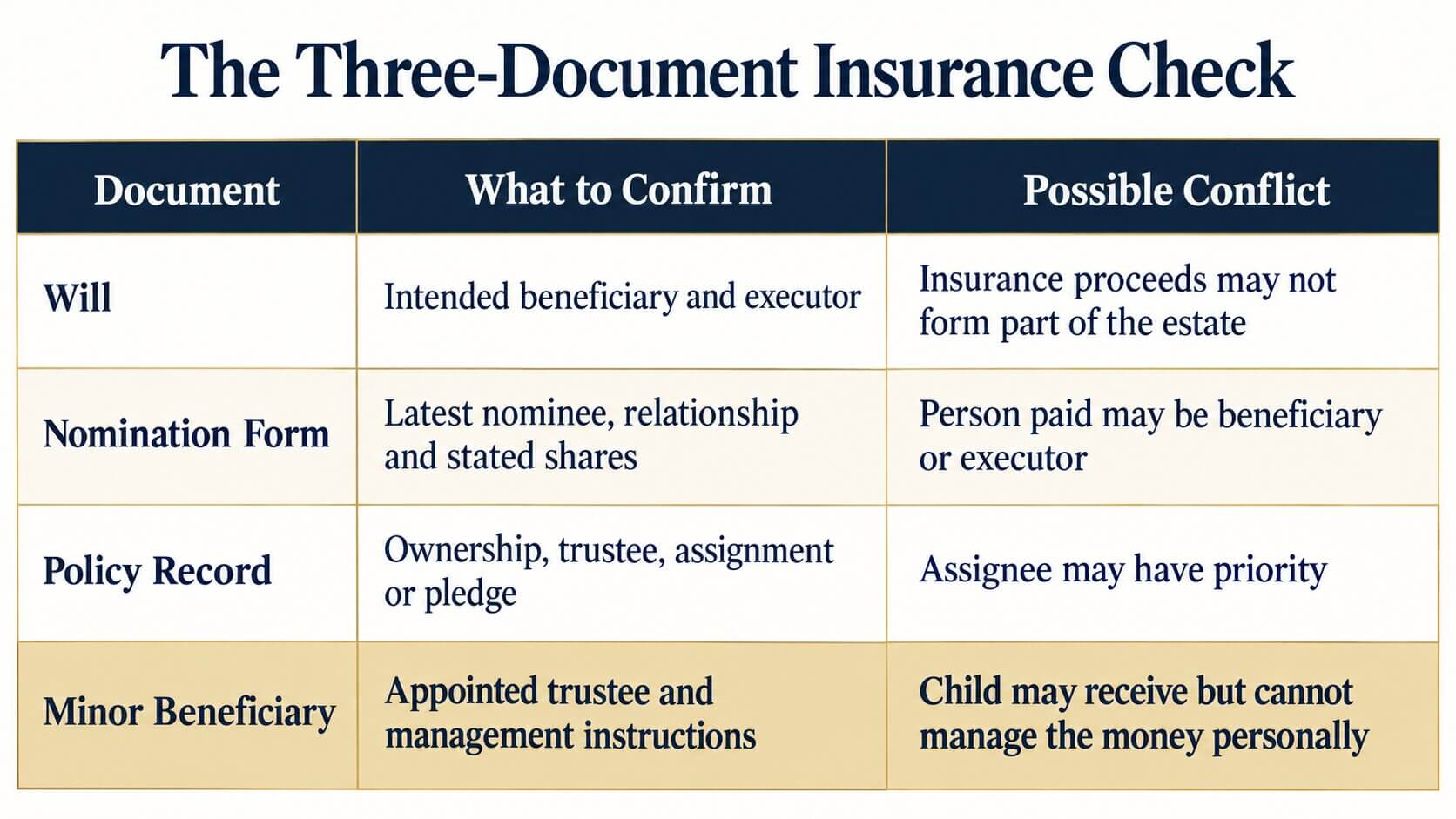
Exhibit A: The will. It gives instructions for assets that fall into the deceased’s estate and appoints an executor to administer them.
Exhibit B: The insurance nomination. It tells the insurer whom to pay after the policy owner’s death. However, being the person paid by the insurer does not always mean being the person entitled to keep the money.
Exhibit C: The policy record. It reveals facts that neither document may show clearly: the type of policy, the identity of the policy owner, the relationship between the nominee and policy owner, whether a trustee was appointed, and whether the policy was assigned or pledged to another party.
Those details determine the legal route of the payout.
For conventional life insurance in Malaysia, Schedule 10 of the Financial Services Act 2013 distinguishes between a nominee who receives the policy money beneficially under a statutory trust and a nominee who receives it as an executor of the policy owner’s estate.
It also states that a nomination is not revoked merely by making a will. A policy owner generally needs to revoke the nomination in writing or make a later nomination in the prescribed manner.
This produces a result that sounds contradictory but is legally important:
A will does not cancel the nomination, yet the will may still determine who ultimately inherits the insurance money.
To see how both statements can be true, return to Mr Lim’s case and change just one fact at a time.
Verdict One: The Nominee Receives—and Keeps—the Insurance Money
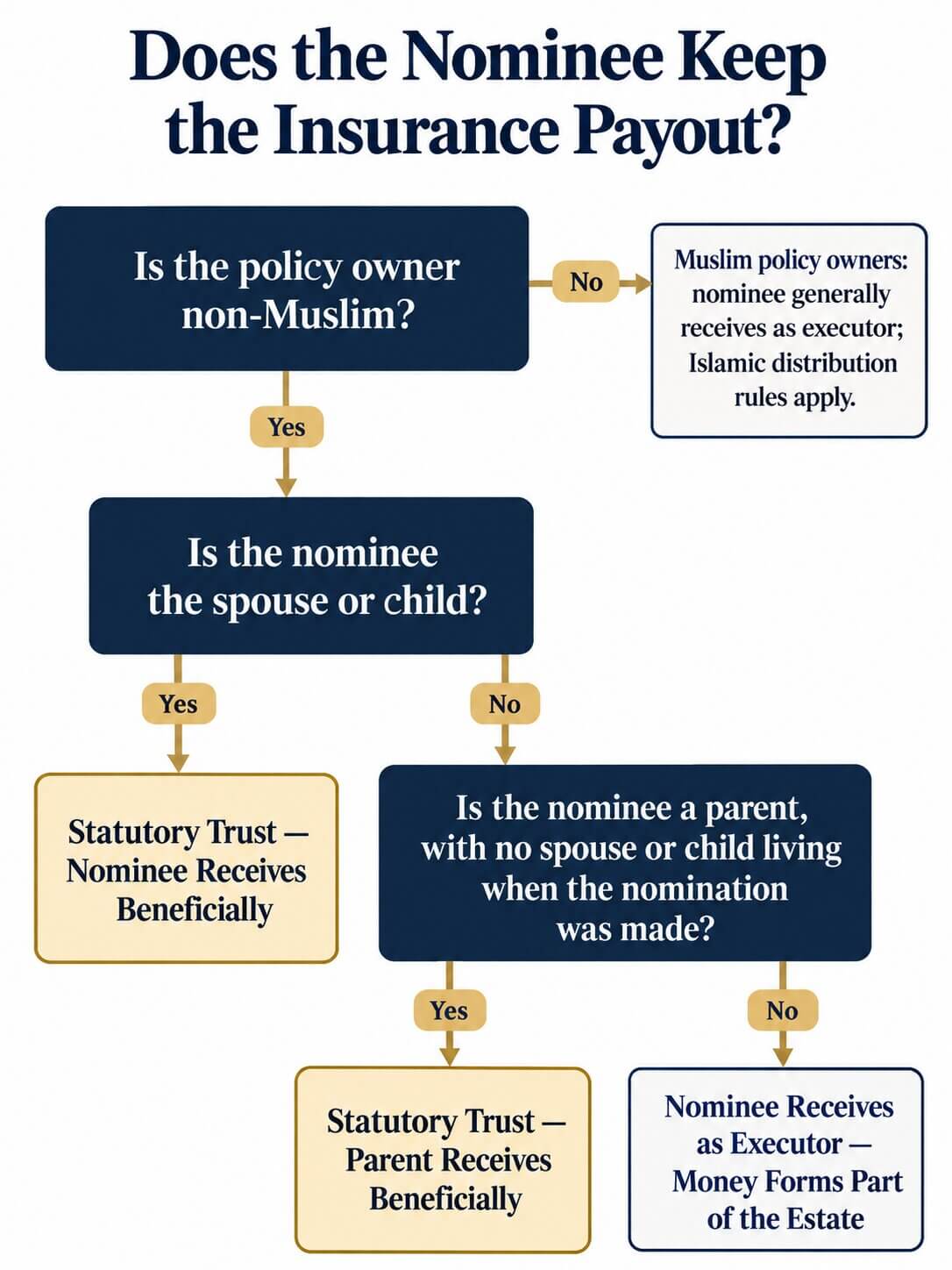
Suppose Mr Lim is a non-Muslim policy owner and his wife, Sarah, is the named nominee.
Under the Financial Services Act 2013, a nomination in favour of a spouse or child creates a trust over the policy money. A nomination in favour of a parent can also create this trust if the policy owner had no living spouse or child at the time of nomination.
In this situation, the nominee receives the proceeds beneficially. The money does not form part of the deceased policy owner’s estate and is generally not available to pay the deceased’s debts.
The practical verdict is straightforward:
- The insurer pays Sarah as the nominated spouse.
- Sarah receives the payout for her own benefit.
- The will cannot redirect that payout to Amanda or another beneficiary.
- The policy money does not wait for the rest of the estate to be distributed through probate.
This is why a sentence in a will saying “I leave all my assets to my daughter” may not capture a life insurance payout already held under a statutory trust for a nominated spouse.
It also answers a common question about the next generation: children do not automatically inherit every insurance payout simply because they are the deceased’s children. A child may receive the payout if named as a nominee within the statutory trust category. If another qualifying family member is validly nominated, that nomination can produce a different result from the general gifts written in the will.
What if the nominated child is still a minor?
Naming a child does not mean an insurer will simply transfer a large sum into a minor’s personal control.
The policy owner may appoint a suitable trustee for the policy money. If no trustee has been appointed, the legislation provides mechanisms for payment to an appropriate trustee, which may include the surviving parent, the Public Trustee or a trust company depending on the circumstances.
The better question is therefore not only “Will my child receive the money?” It is also “Who will hold and manage it until my child can do so?” Families with young beneficiaries should coordinate the nomination with their wider Family Asset Execution Plan instead of leaving this decision to default mechanisms.
Verdict Two: The Nominee Receives the Money—but Does Not Own It
Now return to the original facts. Mr Lim’s daughter is named in the will, while his brother Daniel is named in the insurance nomination.
For a non-Muslim policy owner, a nominee outside the statutory trust categories—such as a sibling, friend, unmarried partner or more distant relative—generally receives the policy money as an executor, not as its beneficial owner.
Daniel may therefore be the correct person for the insurer to pay without being the person who is legally entitled to keep the payout.
The money forms part of Mr Lim’s estate. It is subject to the deceased’s debts and must be distributed according to the valid will. If Mr Lim left no valid will, the applicable intestacy law would determine the beneficiaries.
On these facts, the route is:
Insurer → Daniel as nominee/executor → Mr Lim’s estate → debts and administration → Amanda under the will
The insurer’s payment to Daniel does not rewrite the will. Daniel is the receiving hand, while Amanda may remain the ultimate beneficiary.
This distinction is where many family disputes begin. A relative sees his name on the nomination form and assumes the deceased intended a personal gift. Another relative sees her name in the will and assumes the insurer must pay her directly. Each person is reading one document, while the legal answer requires both.
The same problem can arise when a parent is nominated. A parent is not always a beneficial nominee. If the policy owner had a living spouse or child when the parent was nominated, the parent may fall outside the statutory trust category and receive as executor instead.
Where policy proceeds enter the estate, they may also become entangled with the administration process. The executor may need the appropriate grant and must account for liabilities before distribution. The probate process in Malaysia therefore remains relevant even though the insurer has a nominee on record.
The quick comparison
| Facts at the Policy Owner’s Death | Who Does the Insurer Pay? | Does the Nominee Keep the Money Beneficially? | Does the Will Control the Payout? |
| Non-Muslim policy owner; nominee is spouse or child | The nominee | Generally yes, under a statutory trust | Generally no |
| Non-Muslim policy owner; nominee is a parent and there was no living spouse or child when nominated | The nominated parent | Generally yes, under a statutory trust | Generally no |
| Non-Muslim policy owner; nominee is a sibling, friend or other person outside the trust category | The nominee as executor | Generally no | Yes, after debts and administration |
| Non-Muslim policy owner; no valid nomination | The lawful executor or administrator, subject to statutory payment provisions | Not applicable | Generally yes, because the money forms part of the estate |
| Policy has been validly assigned or pledged | The assignee or security holder has priority to the extent of its interest | Nominee receives only any remaining balance | Depends on the legal character of the balance |
This table is a starting point, not a substitute for checking the policy and nomination records. A trust created by a nomination can also restrict later attempts to surrender, vary, pledge or assign the policy without the required trustee’s written consent.
The Twist: A Fourth Document May Jump Ahead of Both
So far, the dispute appears to involve two competing documents. In some cases, however, neither the will nor the nominee is first in line.
If the policy has been validly assigned or pledged—perhaps to a bank as security—the rights of the assignee or security holder take priority over the nominee. The insurer pays that superior interest first, and only the balance is dealt with under the nomination.
Other facts can also change the outcome:
- A later nomination: The most recent valid nomination generally revokes an earlier nomination.
- A written revocation: A policy owner may revoke the nomination by giving written notice to the insurer.
- The nominee dies first: The nomination may be revoked if the sole nominee, or all nominees, die during the policy owner’s lifetime.
- Several nominees: The payout follows the shares stated in the nomination; if no shares are stated, equal shares may apply.
- No valid nominee remains: The policy money may be paid to the lawful executor or administrator, subject to the Act’s provisions allowing limited direct payments in certain circumstances.
- A Muslim policy owner: Under the conventional insurance framework, the nominee generally receives the money as executor and must distribute it according to Islamic law.
- A takaful certificate: Takaful nominations and conditional hibah operate under a different legal and contractual framework and should not be treated as identical to a conventional life insurance nomination.
This article focuses on conventional life and relevant personal accident policies governed by Schedule 10 of the Financial Services Act 2013. EPF nominations, takaful nominations, trust instruments and jointly owned assets each operate under their own rules.
That boundary matters. “I have named a nominee” is not a complete estate plan when different assets attach different legal consequences to the same word.
Put the Documents on One Table Before Your Family Has To
Mr Lim’s case cannot be solved by asking whether a will is “stronger” than a nomination. The right question is what legal role the nomination gives to the person named.
If the nominee is a qualifying spouse, child or parent, the payout may be held under a statutory trust and remain outside the estate. If the nominee is a sibling, friend or another person outside that category, the nominee may receive the money only as executor, with the will deciding who ultimately inherits it. A valid assignment or pledge may take priority over both.
You can test your own arrangement without starting with a thick estate file. Put these three documents on the table:
- Your latest will
- Your current insurance policy schedule
- The latest nomination acknowledged by your insurer
Then write down the answer to five questions:
- Is the nominee meant to own the payout or only receive it for someone else?
- Does the nominee’s relationship to you produce that legal result?
- Do the names and shares match your current intention?
- Has the policy been assigned, pledged or placed under a trust?
- If a minor is to benefit, who will manage the money and on what terms?
Do not wait for an insurer’s payment letter to reveal that the three documents tell three different stories. If they do not point to the same intended outcome, arrange a document-alignment discussion with Sim & Rahman while you are still able to correct the record yourself.
This article provides general information only and does not constitute legal advice. The outcome depends on the policy type and terms, the policy owner’s religion, the identity and relationship of the nominee, the date and validity of the nomination, any trust, assignment or pledge, and the law applicable to the estate.