

Who inherits your estate without a will in Malaysia? Many people assume that everything will automatically pass to their spouse or children—but the legal outcome can be very different.
If you are a non-Muslim covered by the Distribution Act 1958, the law decides who inherits your estate and the percentage each person receives. Your family’s financial needs, personal relationships and assumptions about what you “would have wanted” do not change that formula.
Understanding these rules now will show whether the law produces the outcome you actually intend for your family.

Which Inheritance Law Applies When There Is No Will?
A person who dies without leaving a valid will is described as having died “intestate”. The part of the deceased’s property that has not been validly disposed of becomes the intestate estate.
For non-Muslims in Peninsular Malaysia, the distribution of that estate is generally determined by the Distribution Act 1958. The Act has also been extended to Sarawak, although local modifications and native customary laws may affect certain estates.
Different inheritance rules may apply when:
- The deceased was a Muslim
- The deceased or the assets were connected to Sabah
- The deceased was domiciled outside Malaysia
- The estate includes overseas property
- Native customary inheritance laws apply
- The ownership structure of an asset affects whether it forms part of the estate
Muslim estates are generally distributed according to Islamic inheritance principles, including Faraid. Families who require Syariah-compliant planning may need to consider suitable arrangements such as Hibah and Wasiat.
This article focuses primarily on the intestate estates of non-Muslims governed by the Distribution Act 1958.
Who Receives the Estate—and How Much Does Each Person Get?
The Distribution Act 1958 first considers three main groups of beneficiaries:
- The deceased’s surviving spouse
- The deceased’s “issue”
- The deceased’s surviving parent or parents
“Issue” is a legal term that includes the deceased’s children and, in certain circumstances, the descendants of a child who died before the deceased.
The beneficiaries and their respective percentages depend on which of these family members are alive when the deceased passes away.
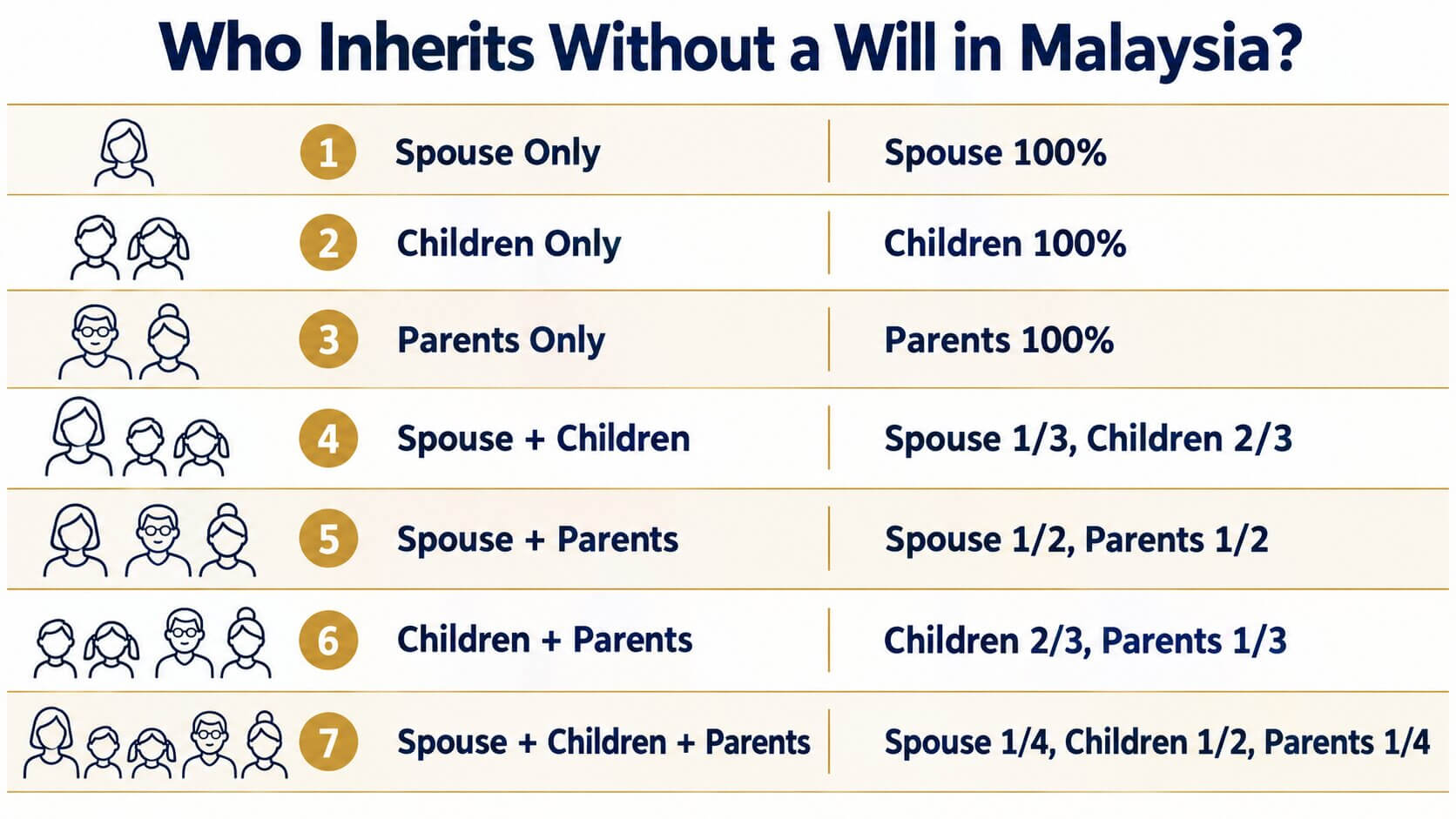
| Surviving Family Members | Spouse’s Share | Issue’s Share | Parent or Parents’ Share |
| Spouse only | 100% | — | — |
| Issue only | — | 100% | — |
| Parent or parents only | — | — | 100% |
| Spouse and issue | 1/3 | 2/3 | — |
| Spouse and parent or parents | 1/2 | — | 1/2 |
| Issue and parent or parents | — | 2/3 | 1/3 |
| Spouse, issue and parent or parents | 1/4 | 1/2 | 1/4 |
These percentages apply to the distributable estate after the relevant administration expenses, debts and liabilities have been settled. They do not necessarily apply to the gross value of everything the deceased appeared to own.
The Malaysian Government also provides an external Act 300 inheritance calculator for non-Muslim estates. It can be used as an initial guide, but it does not replace legal advice for complex family or asset structures.
Scenario 1: The Deceased Leaves a Spouse and Two Children
Assume that the net distributable estate is worth RM1.2 million. The deceased leaves a spouse and two children but has no surviving parents.
The spouse receives one-third of the estate:
RM1,200,000 × 1/3 = RM400,000
The two children collectively receive the remaining two-thirds:
RM1,200,000 × 2/3 = RM800,000
If both children are entitled in equal shares, each child receives RM400,000.
The spouse does not automatically inherit the entire estate merely because the couple was married.
Scenario 2: The Deceased Leaves a Spouse and Parents but No Children
If the same RM1.2 million estate is left to a spouse and both parents, the spouse receives half of the estate:
RM1,200,000 × 1/2 = RM600,000
The parents collectively receive the other half. If both parents are entitled, each generally receives RM300,000.
This means the spouse may have to share inherited property with the deceased’s parents, even if the spouse was financially dependent on the deceased.
Scenario 3: The Deceased Leaves a Spouse, Children and One Parent
This combination often produces the most unexpected outcome.
If the net estate is RM1.2 million:
- The spouse receives one-quarter: RM300,000
- The children collectively receive one-half: RM600,000
- The surviving parent receives one-quarter: RM300,000
The law does not ask whether the surviving parent is already financially secure or whether the spouse needs the whole estate to support the children.
The legal shares are determined by the surviving family structure—not by who appears to need the inheritance most.
What Happens If a Child Dies Before the Parent?
The term “issue” can include descendants of a child who died before the deceased.
For example, imagine that Mr Tan had two children, Adam and Bella. Adam passed away before Mr Tan but left two children of his own.
Depending on the full circumstances, Adam’s children may collectively inherit the share Adam would have received if he had survived Mr Tan. Bella would receive her own branch’s share, while Adam’s two children would divide the portion allocated to Adam’s branch.
The calculation therefore does not always depend simply on the number of surviving children. The family tree and the order in which family members died can affect the final distribution.
Additional legal questions may arise when the family includes:
- Adopted children
- Stepchildren
- Children from different marriages
- A child whose parentage is disputed
- A beneficiary who died shortly after the deceased
- Children who are still under the age of majority
A stepchild, for example, does not automatically become an intestate beneficiary merely because the deceased raised or financially supported that child. The child’s legal relationship with the deceased must be examined.
Who Inherits If There Is No Spouse, Child or Parent?
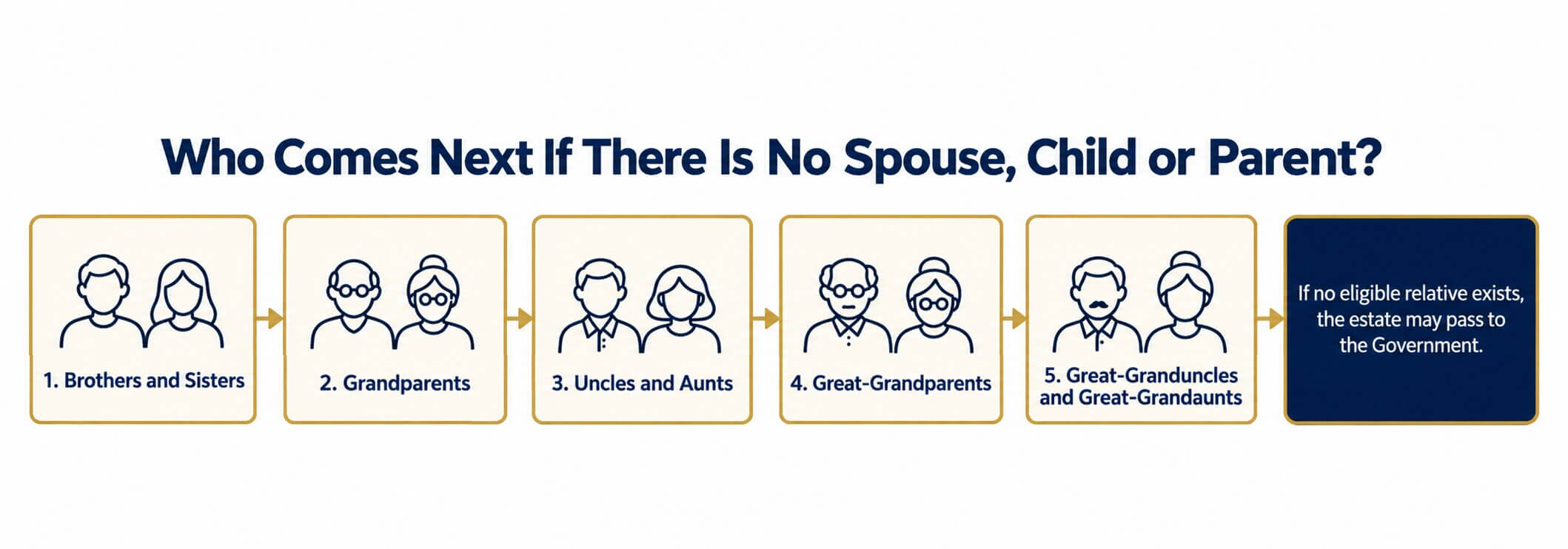
If the deceased leaves no surviving spouse, issue or parent, the estate may pass to more distant relatives according to the following order:
- Brothers and sisters
- Grandparents
- Uncles and aunts
- Great-grandparents
- Great-granduncles and great-grandaunts
Eligible descendants of certain relatives may also need to be considered.
If nobody within the statutory categories is legally entitled to inherit, the estate may ultimately pass to the government.
A close friend, long-term unmarried partner, caregiver, godchild or charitable organisation does not automatically inherit under the Distribution Act simply because the person had a close relationship with the deceased.
Why a Legal Percentage Can Turn One House Into a Family Problem
Inheritance percentages are relatively easy to apply when an estate consists mainly of cash. The situation becomes more difficult when most of the family wealth is tied up in a house, shop lot, landholding or private company.
Consider a deceased person who leaves a spouse, two children and a surviving mother. The main asset is a fully paid RM1.2 million family home.
Under the applicable statutory formula:
- The spouse is entitled to 25%
- The two children collectively receive 50%
- The mother receives 25%
The house cannot be physically divided according to those percentages.
The beneficiaries may have to consider several options:
- Registering the property under multiple names
- Selling the house and dividing the net proceeds
- Allowing one beneficiary to purchase the others’ interests
- Entering into a legally documented family arrangement, where permitted
If the spouse wishes to remain in the family home but does not have enough cash to purchase the other beneficiaries’ interests, the inheritance can create an immediate liquidity problem.
Multiple ownership can also complicate future decisions. Selling, refinancing or redeveloping the property may require agreement between beneficiaries with different financial priorities.
A will may provide clearer instructions about the property, but the plan must still be financially practical. Families with businesses, investment properties or concentrated assets may need a broader Family Asset Execution Plan to determine how those instructions will be carried out.

Being an Heir Does Not Mean Receiving the Assets Immediately
The Distribution Act determines who is entitled to the estate. It does not automatically give the beneficiaries immediate access to the deceased’s bank accounts or authority to transfer the deceased’s property.
When there is no valid will, an eligible person will generally need to obtain the appropriate legal authority to administer the estate. Depending on the circumstances, this may involve applying for a Letter of Administration in Malaysia.
The authorised administrator is responsible for matters such as:
- Identifying and collecting the deceased’s assets
- Confirming the beneficiaries
- Paying outstanding debts and administration expenses
- Dealing with the relevant banks, land offices and institutions
- Distributing the remaining estate according to the applicable law
Until the proper authority is obtained, financial institutions and government bodies may refuse to release or transfer the assets.
This is why legal entitlement and actual access are two different matters. Your spouse may be entitled to a percentage of your estate, but that does not mean the money or property will be transferred immediately after your death.
Not every asset necessarily follows the same inheritance table either. EPF savings, insurance proceeds, trust assets, jointly owned property and assets held through companies may require separate legal analysis.
For a broader explanation of the administration process, read what happens when someone dies without a will in Malaysia.
Decide Who Should Inherit Before the Law Decides for You
The Distribution Act provides a fixed solution when no effective instructions have been left. However, it does not know which family member depends on you, who should take over the family business or whether your spouse can afford to share the family home with other beneficiaries.
A properly prepared estate plan can help you:
- Choose the people who should inherit
- Determine the share each beneficiary should receive
- Appoint a suitable person to administer the estate
- Give practical instructions for important properties
- Make arrangements for beneficiaries who are minors
- Create liquidity for debts and immediate family expenses
- Coordinate the will with nominations, trusts and business arrangements
Estate planning does not always mean excluding the people who would inherit under the law. It allows you to confirm, adjust and structure the outcome intentionally.
If the statutory distribution above does not reflect what you want for your spouse, children, parents or family assets, contact Sim & Rahman to discuss your estate planning options before those decisions are left to a fixed legal formula.
This article provides general information only and does not constitute legal advice. The applicable outcome depends on factors including the deceased’s religion, domicile, family relationships, asset ownership and the laws governing each asset.