

Parents who want to protect inheritance from a child’s spouse are usually not trying to interfere with the marriage. They want wealth built over decades to support their child and future generations without becoming unnecessarily exposed if the marriage later breaks down.
The important question is not only who receives the inheritance. It is also who owns it, who controls it and what happens to it after distribution. Those decisions should be made while the family is on good terms—not after a dispute begins.

The Risk Often Begins After the Inheritance Is Received
An inheritance does not necessarily become matrimonial property simply because a child is married. However, it should not be assumed that every inherited asset will remain beyond dispute regardless of how it is later handled.
For non-Muslim civil marriages, section 76 of the Law Reform (Marriage and Divorce) Act 1976 gives the court power to divide assets acquired during a marriage. Relevant considerations include the parties’ financial and non-financial contributions, family welfare, joint debts, the needs of minor children and the duration of the marriage.
The provision also states that assets owned before marriage may be included where they were substantially improved during the marriage by the other spouse or through joint efforts. Although inheritance presents a different factual question, this illustrates why the history and treatment of an asset matter.
The result is not an automatic 50:50 division, nor is it an automatic exemption. The court considers the applicable law and evidence in the particular case.
For Muslim families, claims involving harta sepencarian are governed by the relevant Syariah law and state procedures. Advice must therefore be tailored to the family’s jurisdiction and circumstances.
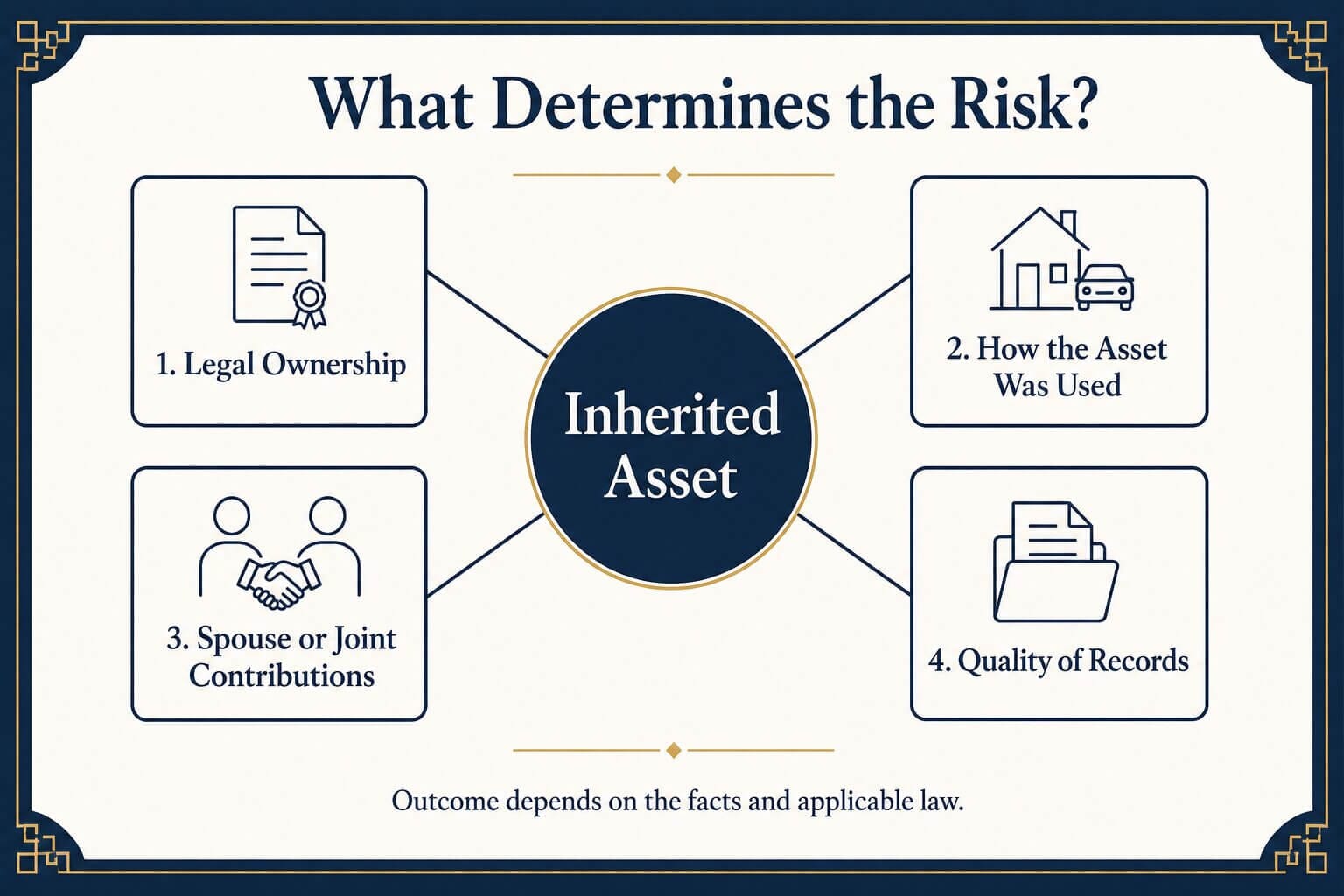
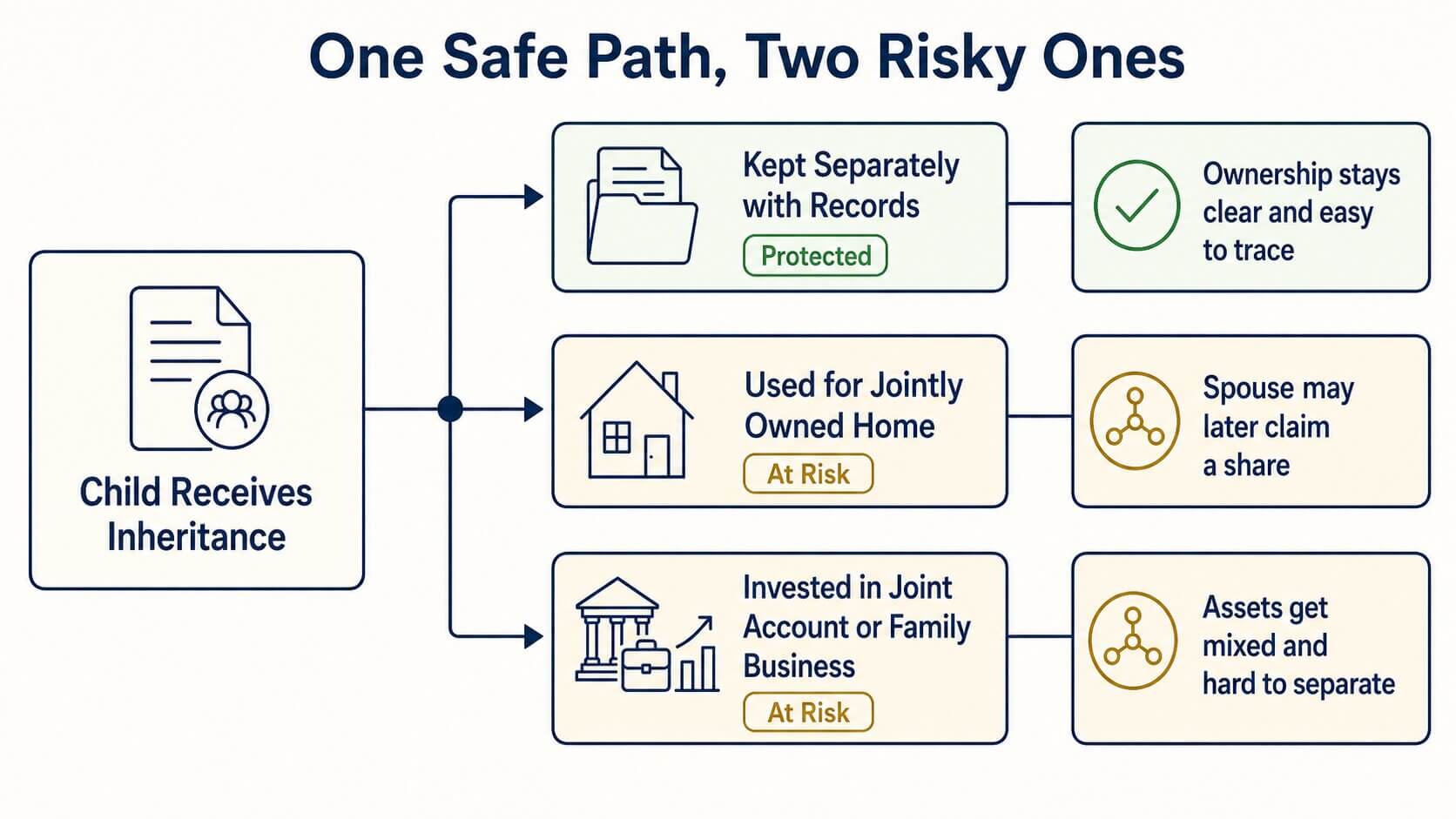
Three Decisions That Can Make Ownership Less Clear
The parent may leave an asset solely to the child, but the child’s decisions after receiving it can blur the distinction between inherited wealth and family wealth.
Depositing the money into a joint account
Inherited funds that are repeatedly mixed with salaries, household savings and joint investments may become harder to trace. Separate banking records do not decide a matrimonial claim, but they can provide useful evidence of the source and movement of the money.
Using the inheritance for the matrimonial home
A child may use inherited cash as a deposit for a jointly registered home or apply it towards the housing loan. An inherited property may also be renovated or extended through the spouse’s financial contribution or the couple’s joint efforts.
These arrangements may create questions that would not arise if the asset had remained separately owned and independently maintained.
Transferring wealth into a jointly run business
The inheritance may be invested in a company operated by both spouses, or inherited shares may increase in value while the spouse works in the business. Ownership records, shareholder rights, management contributions and the source of further capital may all become relevant.
The practical lesson is simple: if the parent wants the inheritance to remain identifiable, the family should document its source and think carefully before changing its ownership or purpose.
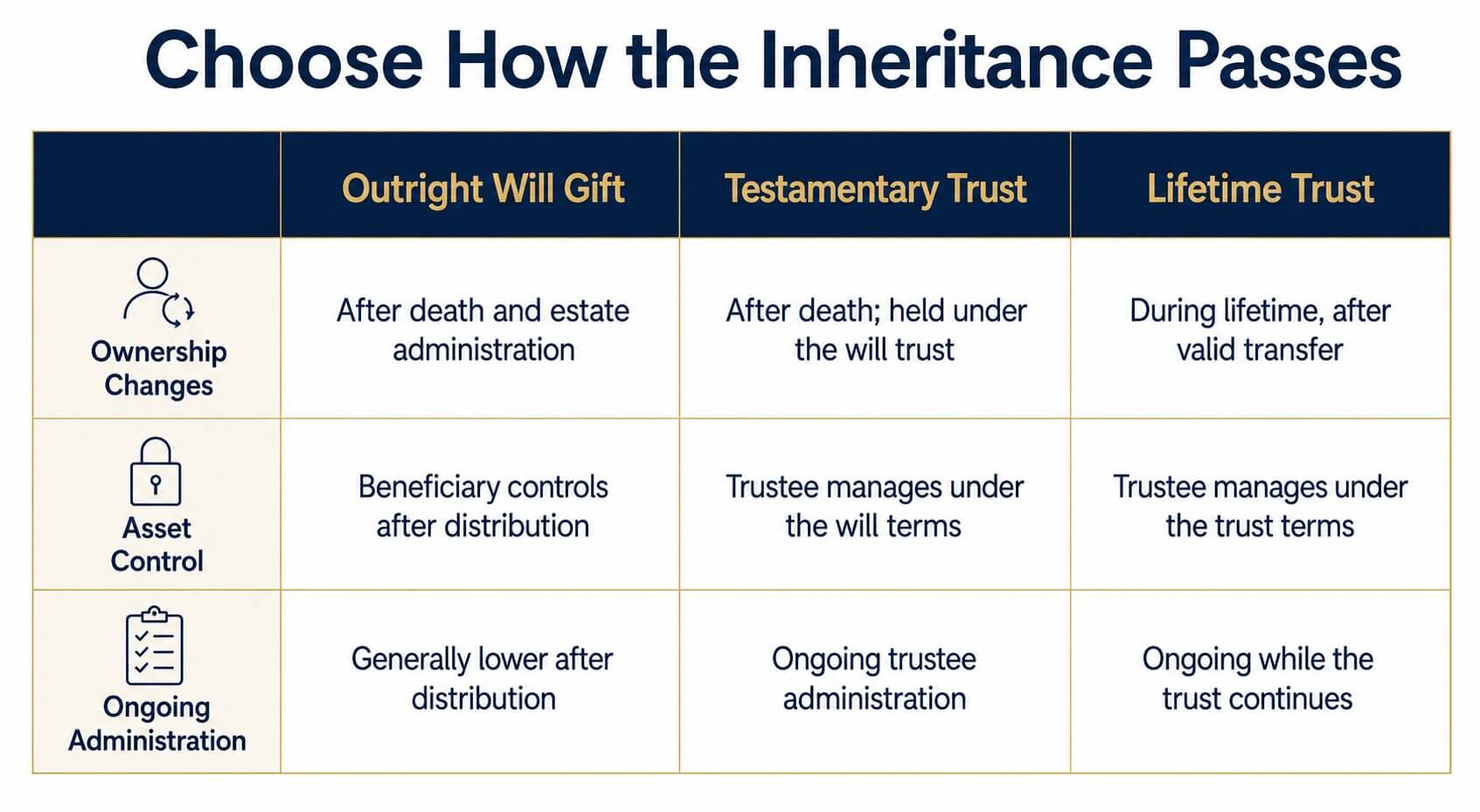
Choose the Protection Level Before Ownership Passes
The strongest opportunity to protect inheritance from a child’s spouse usually arises before the child receives unrestricted ownership. Parents should first decide how much access and control the child genuinely needs.
There is no single structure that suits every family:
| Planning method | How the child benefits | Main consideration |
| Outright gift under a will | The child receives full ownership after estate administration | Simple, but the parent loses control once the asset is transferred |
| Testamentary trust | The trustee manages the inheritance under terms that take effect upon the parent’s death | Can preserve capital and regulate distributions, but requires careful drafting and administration |
| Lifetime trust | Assets are transferred and administered during the parent’s lifetime | May allow earlier governance and continuity, but timing, tax, control and transfer consequences require professional review |
An outright gift may still be suitable for an adult child who is financially responsible and whose inheritance is straightforward. A trust may be more appropriate where the estate includes substantial capital, vulnerable beneficiaries, private-company shares or a goal of preserving wealth for grandchildren.
The choice should reflect the parent’s real intention. A structure created only to look protective on paper, while allowing the child unrestricted personal control in practice, may not achieve the desired separation.
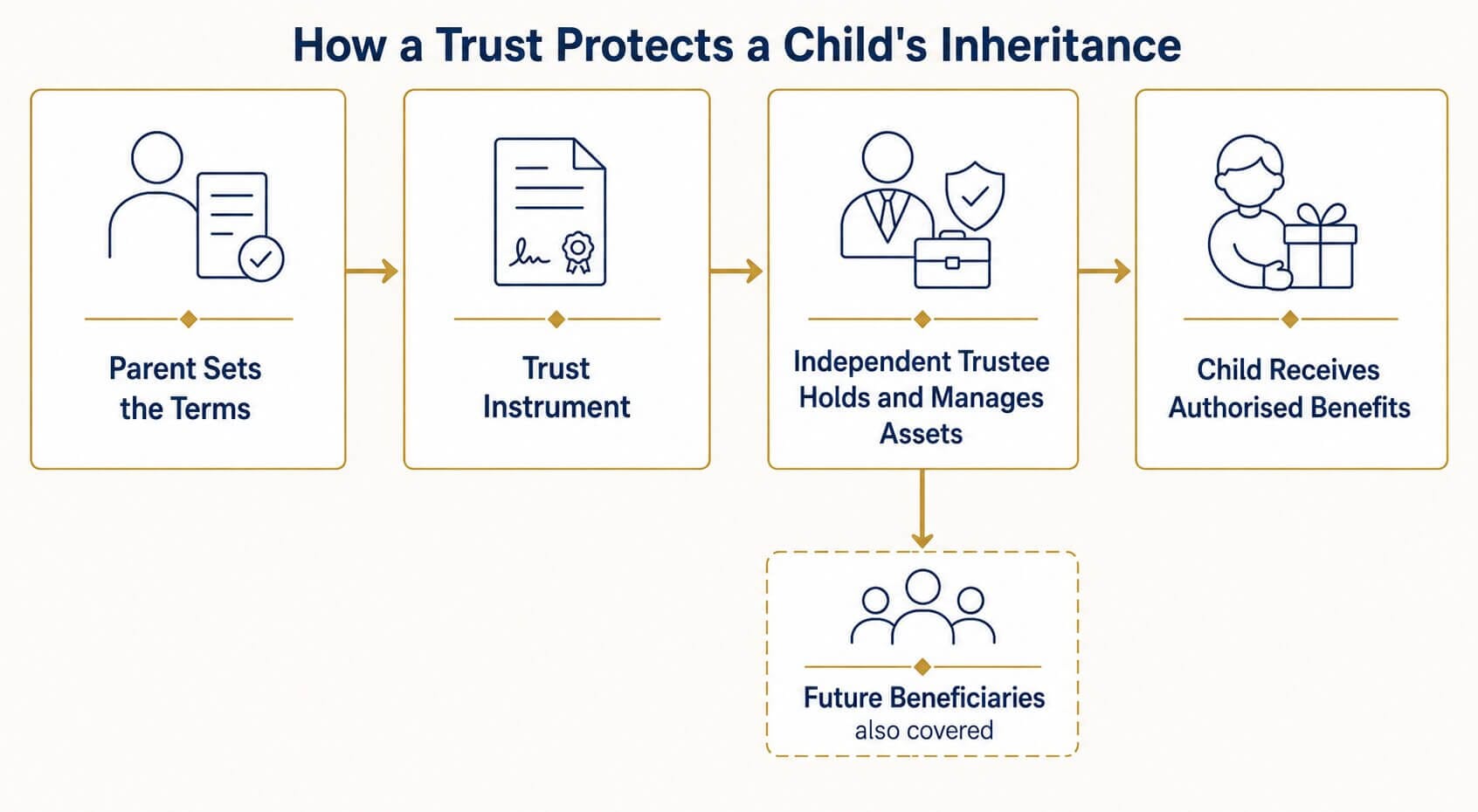
A Trust Works Only When Control Is Meaningfully Separated
A trust can add a layer of protection because the trustee holds and administers the trust assets according to the trust instrument. The child benefits under those terms instead of receiving the entire inheritance as unrestricted personal property on one date.
That distinction must exist in substance as well as in the documents. If the child is the sole trustee, can demand every asset immediately or treats trust property as a personal account, the arrangement may provide less practical separation than the parent intended.
An effective design may address:
- whether an independent or professional trustee is appropriate;
- how trustees are appointed, removed and replaced;
- whether distributions are fixed, staged or discretionary;
- which needs may be supported, such as education, healthcare, housing or maintenance;
- whether capital should ultimately pass to the child, grandchildren or other beneficiaries; and
- how decisions and distributions will be documented.
These terms should not be copied from another family’s trust. A founder with operating-company shares may need a very different arrangement from a parent leaving an investment portfolio to a young adult child.
No trust should be marketed as “divorce-proof”. Its effectiveness depends on its genuine purpose, timing, drafting, administration and the degree of control retained by the relevant parties. A sham arrangement, or a transfer intended to defeat an existing legal claim, may be challenged.
A tailored Family Asset Execution Plan can help coordinate the trust terms with the will, asset ownership and the practical steps required to implement the plan.
Business Shares and Property Need Their Own Safeguards
For an ultra-high-net-worth family, a will and trust are only part of the solution. The estate may include operating-company shares, investment entities, real estate, intellectual property and assets in more than one jurisdiction.
Private-company shares should be reviewed alongside the company constitution and shareholders’ agreement. Transfer restrictions, voting rights, valuation methods and buy-sell arrangements may be needed to prevent succession from disrupting the business or creating unintended control issues.
Property requires equally careful treatment. Before transferring a title or placing real estate into a structure, the family should review financing terms, co-ownership, registration requirements and the legal consequences of the proposed transaction.
A family office structure may help coordinate governance, reporting and succession across several entities. Where a private business forms part of the legacy, the estate documents should also align with the family’s corporate legal arrangements.

Put the Plan in Place Before Circumstances Change
The purpose of planning is not to restrict the child’s life or assume that a marriage will fail. It is to decide deliberately which assets should pass outright, which should remain under stewardship and what records will be needed to preserve the family’s intentions.
Begin by mapping every significant asset and its current legal owner. Then decide the level of access the child should have, align the will and trust with the relevant property and company documents, and preserve clear records of every transfer and distribution.
The plan should be reviewed after a marriage, divorce, birth, death, business sale, relocation or major change in family wealth. It should also be completed before a conflict exists—not used to hide assets or defeat a spouse’s existing lawful claim.
For some families, separate ownership and good documentation may be sufficient. Others may need a properly administered trust, corporate succession arrangements and coordinated family governance. A trusted law firm in Malaysia can assess the asset structure and prepare a plan suited to the family rather than relying on a standard template.